May 22nd, 2011. It started like any other late spring Sunday in the Midwest. People were getting ready for dinner, flipping through TV channels, maybe thinking about work tomorrow. Joplin High School had held its graduation ceremony at nearby Missouri Southern State University earlier that day, and there was still a steady stream of vehicles driving through Joplin.
By the time most people realised what was coming, it was already too late. The sirens did go off, but then stopped, and then restarted. Very few people realised that a tornado of biblical, apocalyptic proportions was forming just outside town—nearly a mile wide, a savage wall of destruction that would soon devastate Joplin and kill 158 people.
A Town Like Any Other
Before it was a headline, Joplin was just another working-class city trying to get by, home to around 50,000 people. Not rich, not poor—just solid Midwestern folk. A mix of low-slung strip malls, quiet neighborhoods, a few big box stores, and a downtown that still showed signs of life. You wouldn’t necessarily go to Joplin for anything, but it was a perfectly pleasant place to pass through.
Key Takeaways
- A mile-wide tornado devastated Joplin on May 22, 2011, killing 158 people.
- The tornado’s path was chaotic, destroying homes, schools, and hospitals.
- Many residents were unprepared, as the tornado did not resemble typical twisters.
- The community showed resilience, with volunteers and survivors helping each other.
- Joplin’s rebuilding efforts led to improved building codes and mental health support.
People knew each other. You couldn’t go far without bumping into someone from work, church, or the kids’ baseball team. It was the kind of place where Friday nights meant high school football, and Sunday mornings meant church service.
And yet, while Joplin may have carried the air of nothing-special USA, its location meant that all hell could break loose at any time. You see, Joplin sits in a part of the country known as Tornado Alley—a stretch running through the central U.S. where warm, moist air from the Gulf crashes into cold, dry air from the Rockies. It’s a volatile mix, and when it blows up, it can get deadly.
Missouri isn’t the bullseye, but it’s close enough. The state averages around 45 tornadoes a year, and spring is prime time. Sirens are just part of the background here. You hear them, check the radar, glance out of the window if it gets a little blustery, maybe head to the basement if it looks serious. Most of the time, it passes without incident, but every so often, one doesn’t.
The Beast Forms
By late afternoon on the 22nd May, storms had already been rolling through parts of the region, but nothing was out of the ordinary. People had heard the warnings, but this being tornado alley, it wasn’t like people were scrambling into shelters at the first sign of danger. Life carried on as usual.
But out west, just beyond the city, something monstrous was forming. A storm cell started tightening fast with multiple sub-vortices churning inside. Meteorologists tracking it would later say it showed signs of rotation, as if it was going to spare Joplin at the last minute. Tragically, that’s not what happened.
At 5:17 p.m., the National Weather Service issued a tornado warning for Joplin. Thirty-four minutes later, the twister touched down. Now, I’ve used the word twister there—a common informal word to describe a tornado. For some of you, that might bring images to mind from the 1996 film Twister with Bill Paxton and Helen Hunt, where almost elegant tornadoes touch down with swirling funnels and terrorise those crazy enough to chase them.
The Joplin tornado was nothing like that. This was a mile-wide wedge—low, black, and grinding. It moved at around 32 km/h (20 mph), which doesn’t sound like much until you realise it meant people could see it coming, had time to watch it approach, even take a few pictures, but not nearly enough to escape.
The awful thing about this was that people didn’t understand what they were looking at. Rain and debris masked its form, and there was no clear outline, no distant silhouette announcing its arrival. By the time people understood what it was, it was already inside the city limits.
38 Minutes of Hell
The tornado didn’t cut a clean path. It chewed through the city, house by house, store by store. Over the next 38 minutes, it carved a scar nearly 22 kilometres (14 miles) long and more than a kilometre wide. This wasn’t selective. It hit schools, hospitals, churches, gas stations, apartment blocks, and nursing homes. It hit everything and destroyed everything in its path.
At its peak, the winds reached over 320 km/h (200 mph), powerful enough to tear the bark off trees and rip concrete from roads. Entire steel-framed buildings crumpled like they were made of paper. A local fire station was flattened. A Home Depot was shredded, killing seven people inside. Another big-box store, a Walmart, collapsed under the pressure of the winds, trapping dozens and killing three.
St. John’s Regional Medical Center—one of the tallest buildings in town—took a direct hit. The windows blew out, walls crumbled, and the entire structure shifted on its foundation by several inches. Five patients were killed when backup generators failed and their life-support systems shut down. A sixth victim, a visitor, died after being struck by debris.
Joplin High School was reduced to rubble. The massive ironwork letters spelling “JOPLIN” were thrown from the roof and later found blocks away. Several students returning from graduation parties were caught in the chaos, some never making it home.
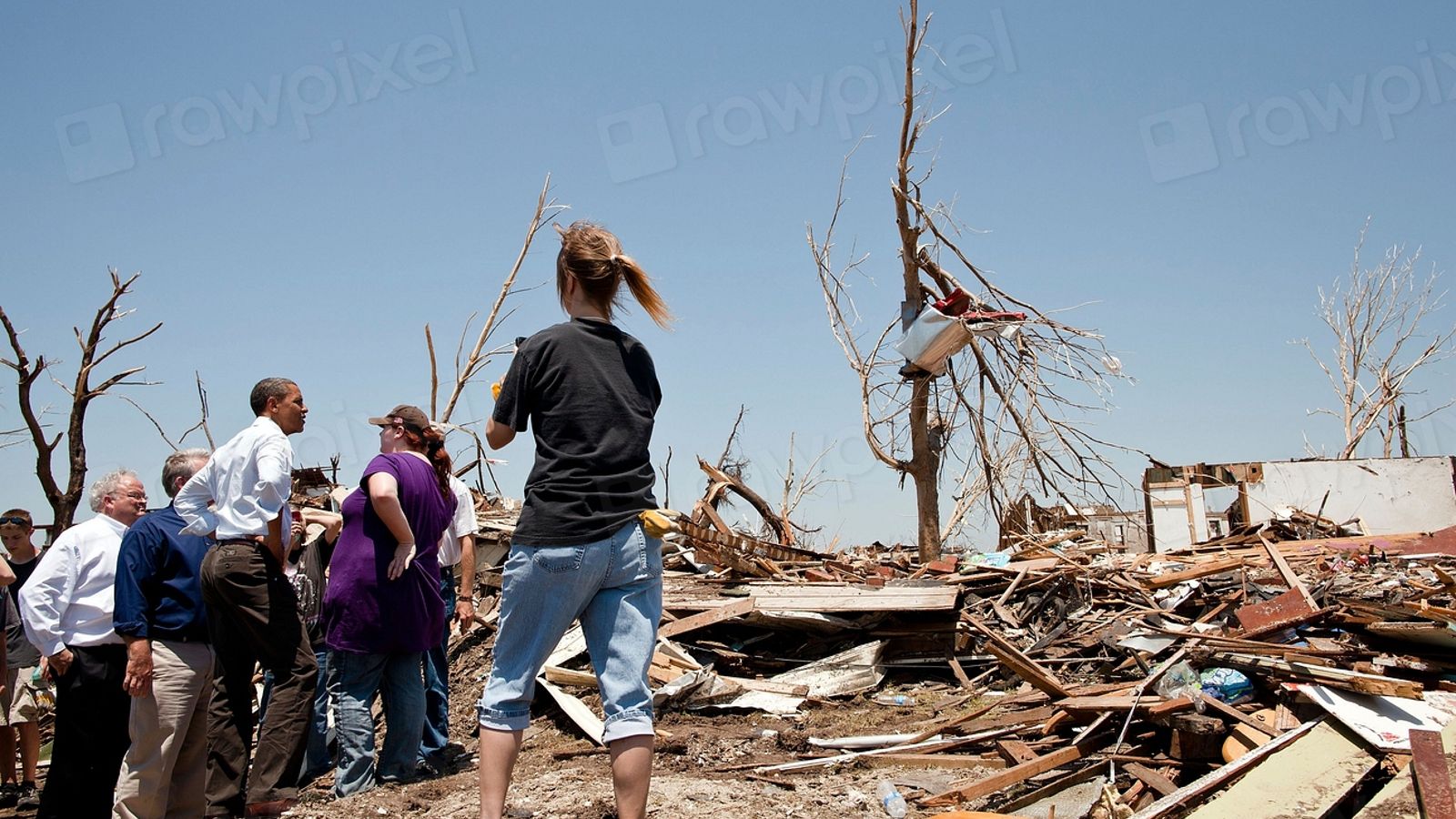
In some neighborhoods, nothing was left. No roofs. No walls. Just bare foundations and piles of splintered wood where homes once stood. Some houses were so thoroughly obliterated that emergency crews couldn’t even find the outlines of their structures. Cars were picked up and tossed into trees, crushed against buildings, or pancaked into heaps of scrap. A concrete parking stop from a strip mall was launched over 400 metres and embedded into the side of a home.
People ran into basements, bathtubs, coolers, closets—anywhere they thought might give them a chance. Some crouched in grocery store freezers, while others lay flat in ditches along the road. The stories from these 38 minutes are difficult to hear. Many said they genuinely believed this was the end of the world. The end of days had arrived in Joplin. There are stories of people desperately holding on to loved ones before they were sucked out of car windows or gaping holes in walls.
And yet, even as the tornado was still tearing through the east side of the city, people were already emerging from the rubble, stunned and bloodied, trying to make sense of what had just happened.
The Dead and the Missing
When the winds stopped, the silence that followed was worse. Joplin looked like a bombed-out war zone. Entire blocks and the people who had lived there were missing. One group of survivors spoke on a recent documentary about getting into their car to drive home to check on their parents and getting lost along the way. They were 18 years old and had lived in Joplin all of their lives, but they couldn’t recognise the mangled carcass of a city around them.
158 people lost their lives that day. Mothers, fathers, children, grandparents. Some died instantly, others were trapped beneath debris with no way out. Rescue workers and volunteers clawed through the rubble with their bare hands, calling out names, listening for anything. Many of the dead were only identified through dental records or DNA testing. Bodies were burned, crushed, or carried miles from where they’d last been seen.
One of the most heartbreaking realities was how many died simply because they didn’t know what they were dealing with. The tornado didn’t look like a tornado, so people thought they had time. Some sheltered in interior rooms that offered no protection, while others were caught in cars, trying to outrun it.
Watch The Project Briefing
Open Video
Video Briefing
When the Apocalypse Came to Missouri.
Several families were nearly wiped out entirely. Tales emerged of parents shielding their kids with their own bodies, some surviving while their children did not. In one case, a father tried in vain to hold on to his newly graduated son before he was sucked out of the car’s smashed sunroof. The body of the 18-year-old was later found near a pond, miles from the incident.
And then there were the missing. For days, no one knew how many were unaccounted for. At one point, over 1,300 people were listed as missing, but that number slowly dropped as people were found injured, in hospitals, or shelters. The uncertainty of it all was agonising. Phones weren’t working. Roads were blocked. Entire families were scattered.
And the dead were everywhere. Not just inside collapsed homes or beneath flattened businesses, but lying out in the open. On roadsides or in parking lots. Emergency responders had to mark their locations with spray paint on the pavement. There’s no real way to process that kind of loss. All you can do is start counting—and even then, the numbers don’t come close to the scale of what was taken.
Chaos and Kindness
In the hours after the tornado passed, Joplin teetered between catastrophe and something close to collapse. There was no power, and water lines were severed. Gas leaks hissed—the air stank of dust, insulation, and something far worse that would linger for weeks.
The first responders were overwhelmed almost instantly. Firefighters, police, paramedics—they were victims too. Some had lost their homes and families, but kept working through the night. Dispatch was a melee of overlapping reports—collapsed roofs, trapped survivors, missing children, fires, looting. Everybody did what they could, but the whole situation was a mess.
Hospitals were barely functioning. St. John’s was ruined, and Freeman Health System, the only other major hospital in town, took in hundreds of patients in the first few hours. Many of them arrived not by ambulance but in pickup trucks, on doors used as stretchers, and even in shopping carts.
But alongside the chaos, something else was happening. People started pulling strangers out of rubble. Teenagers formed human chains to pass buckets of debris. A man used a jack from his pickup to lift a collapsed wall off a trapped woman. Restaurants that were still standing started giving away food. Churches opened their doors to anyone still breathing. Walmart workers handed out bottled water from smashed shelves.
Within 24 hours, volunteers began pouring in—thousands of them. Some from just up the road, while others had driven for hours to help. By the end of the week, the National Guard had arrived, FEMA was coordinating relief, and the wreckage was slowly, painfully being sorted into what could be salvaged—and what couldn’t.
What Was Left Behind
In the days after the storm, the full scale of destruction finally came into focus. It wasn’t just houses that were gone. Entire streets had vanished. Street signs, landmarks, traffic lights, and things people used every day were just not there anymore. People walked through the wreckage like it was someone else’s town.
The east side of Joplin was barely recognisable. Satellite images showed block after block wiped clean, like someone had taken a giant eraser to the map. Some homes were reduced to nothing more than foundation slabs. Others stood twisted and torn apart, their interiors exposed like open dollhouses. All in all, a third of Joplin had been destroyed. More than 7,500 homes were damaged or destroyed, as were hundreds of businesses. All in all, a third of Joplin simply didn’t exist anymore.
People returned—not all, but many. They came back to sift through what was left: family photos, momentos, a single shoe. They salvaged what they could and tried not to think too hard about what they couldn’t. Some families pitched tents on top of their foundations and stayed there, unwilling to leave. Others left and never came back.
Insurance claims were slow—shocker there—but cleanup was slower. The emotional toll wasn’t measured in dollars or debris—it was in the faces of those who stood staring at empty spaces where their lives used to be. The Community Clinic of Southwest Missouri later reported eighteen suicides linked to the storm’s aftermath.
In the following weeks, a second threat appeared—one invisible, and largely unknown. Mucormycosis, a rare fungal infection, began spreading among survivors. Thirteen people who had suffered wounds during the tornado developed the infection, and five died. This wasn’t caused by tainted water or medical error. The fungus came from airborne spores—common in soil and decaying wood—blasted into tissue by wind and debris.
Mucormycosis moves fast. It targets soft tissue, spreads through blood vessels, and causes necrosis. Victims had open wounds, punctures, or blunt-force injuries—ideal pathways. Treatment required urgent surgery to remove infected areas, sometimes including limbs, followed by aggressive antifungal therapy.
Before Joplin, the infection was almost unheard of in otherwise healthy people. But this became the largest known cluster of tornado-related fungal infections in U.S. medical history.
Lessons in Ruin
In the aftermath, Joplin became a case study in meteorology, emergency response, urban planning, trauma care, and psychological resilience. The storm exposed what was strong and what collapsed like a tower of cards.
Building codes were a big one. Before 2011, Joplin didn’t require tornado-safe construction. Most homes didn’t have basements, and the roofs were flimsy. After the storm, new codes were introduced requiring hurricane clips, reinforced walls, and more secure anchoring. It was too late for thousands of structures, but things should be much better for the next major storm.
FEMA faced criticism and praise in equal measure. The federal response was quick compared to past disasters, but that didn’t mean it was smooth. Confusion over housing, delays in debris removal, and mountains of paperwork left many feeling abandoned. It wasn’t chaos, but it wasn’t confidence-inspiring either.
Mental health became its own crisis. PTSD, depression, and anxiety—especially in children—skyrocketed. Entire classrooms had lost friends. Teachers broke down mid-lesson. Counseling centers filled up. Schools had to create new protocols just to help students get through the day.
But for all the trauma, Joplin also became a symbol of something else. Something strong. More than 80% of the destroyed businesses eventually reopened. Homes were rebuilt—differently, better. Graduation ceremonies were held again. Football games resumed. Life didn’t go back to normal. It just went on, because what else can you do? When disaster strikes, when tragedy arrives, you dust yourself down and move forward the best you can.
A year later, President Obama delivered the commencement address at the graduation ceremony at the newly built Joplin High School, and ended with these words, “To the people of Joplin and the Class of 2012, the road has been hard and the day has been long. But we have tomorrow, so we march. We march together, and you’re leading the way, because you’re from Joplin.”
Key Takeaways
- A mile-wide tornado devastated Joplin on May 22, 2011, killing 158 people.
- The tornado’s path was chaotic, destroying homes, schools, and hospitals.
- Many residents were unprepared, as the tornado did not resemble typical twisters.
- The community showed resilience, with volunteers and survivors helping each other.
- Joplin’s rebuilding efforts led to improved building codes and mental health support.

Simon Whistler
Simon Whistler is one of YouTube's most prolific documentary presenters, known for calm, authoritative deep dives into true crime, disappearances, and the world's most enduring unsolved cases. Into the Shadows is his companion archive for the cases he can't stop thinking about.
Frequently Asked Questions
When did the tornado hit Joplin?
The tornado hit Joplin on May 22nd, 2011.
How wide was the tornado that hit Joplin?
The tornado was nearly a mile wide.
How many people died in the Joplin tornado?
158 people lost their lives in the Joplin tornado.
What was the wind speed of the Joplin tornado at its peak?
At its peak, the winds reached over 320 km/h (200 mph).
How long did the tornado stay on the ground in Joplin?
The tornado stayed on the ground for 38 minutes.
What was the length of the path of destruction caused by the tornado?
The tornado carved a scar nearly 22 kilometers (14 miles) long.
What was the width of the path of destruction caused by the tornado?
The width of the path of destruction was more than a kilometer.
What was the speed of the tornado as it moved through Joplin?
The tornado moved at around 32 km/h (20 mph).
How many homes were damaged or destroyed in Joplin?
More than 7,500 homes were damaged or destroyed.
What percentage of Joplin was destroyed by the tornado?
A third of Joplin was destroyed by the tornado.
Sources
- Original Into the Shadows video: When the Apocalypse Came to Missouri.
- Hero image source by National Archives and Records Administration / openverse, cc0.