On June 29, 1995, thousands of shoppers thronged to the Sampoong Department Store in South Korea’s capital, Seoul, as they had done countless times before. At first glance, it seemed to be just another Thursday at the megastore, with people shopping, dining at restaurants, and strolling leisurely. But something was about to go horribly wrong, and it would leave a lasting scar on South Korea.
It started with loud bangs that spread panic throughout the shopping complex. In a matter of seconds, the five-story building came crashing down, trapping hundreds of shoppers and workers under heavy concrete rubble.
More than 500 people lost their lives in the accident, and over 900 others sustained injuries. The Sampoong Department Store collapse remains the worst ever civilian disaster in South Korea, and one of the deadliest building collapses in modern history.
Key Takeaways
- Chairman Lee Joon rejected engineers’ evacuation advice one hour before collapse, prioritizing revenue over 500 lives lost and 900 injured.
- Lee made unauthorized structural changes—thinner columns, wider spacing, misaligned supports, and heavy roof air conditioners—that fatally compromised building integrity.
- Rescue efforts were hampered by lack of equipment, premature heavy machinery use that may have crushed survivors, and water that drowned some victims.
- Lee Joon served only 7.5 years for involuntary manslaughter; victims’ families remain traumatized and dissatisfied with sentences decades later.
- The disaster prompted South Korea to overhaul building safety codes and emergency response, revealing 98% of high-rises previously failed safety standards.
But this accident didn’t happen out of the blue. Months before the collapse, the management of the shopping center knew about the web-like cracks in the building that were spreading and growing wider by the minute.
In fact, about an hour before the structure crumbled, Lee Joon, the chairman of the Sampoong Group’s construction division, rejected the advice of engineers to evacuate the store. Lee prioritized his profit over the well-being of hundreds of people, and as a result, many lost their lives.
The Sampoong Department Store collapse is a story of greed, corruption, and gross disregard for safety. At the center of this tragic tale is Lee Joon and the Sampoong Group.
A construction boom in Seoul
To understand how the Sampoong Group could blatantly violate building safety regulations and put hundreds of lives at risk, we need to briefly examine South Korea’s path to urbanization.
At the end of the Korean War in 1953, South Korea’s economy was in shambles, and the country was highly dependent on foreign aid. But, only a few decades later, it would emerge as a regional economic powerhouse, successfully shifting from an agrarian economy to a highly industrialized one.
This transformation has been described as a miracle, and nowhere was this more evident than in the country’s capital.
Seoul was one of the most bombed cities during the Korean War. By the time the conflict ended, most public infrastructure in the city was severely damaged or completely out of service. In the decades that followed, South Korea’s leaders invested heavily in rebuilding and urbanizing Seoul. This was part of the government’s strategy to drive industrialization, support the city’s growing population, and ultimately revive the economy. And, it worked.
By the ’80s and ’90s, Seoul was one of the most modern cities in Asia. The city was experiencing a construction boom, with new projects being commissioned every other day. Several shopping malls were built around Seoul during this period, marking a significant growth in the city’s retail industry.
When Seoul was selected to host the 1988 Summer Olympics, there was a fresh impetus to this building spree.
Back then, South Korea’s laws prohibited foreign companies from being awarded construction contracts. So, local firms were solely responsible for these building projects. And, they had to work at breakneck speeds to keep up with the ever-growing demand for their services.
This pressure to finish their work quickly, along with lax supervision and widespread corruption, created a situation where contractors could routinely cut corners and use substandard materials.
The Sampoong Department Store collapse wasn’t the first time South Korea had to pay the price for its fixation with rapid urbanization. About nine months before the accident at the shopping center, the Seongsu Bridge, which connects two of Seoul’s most important regions, collapsed due to structural failure, claiming the lives of over 30 people. At the time, no one would have imagined that a far greater disaster lay ahead.
Building the Sampoong Department Store
Lee Joon was an ambitious ex-military officer when South Korea was undergoing a rapid transformation. He set up a construction company to capitalize on the building frenzy and scored a few relatively small projects with the government and the US military. But he longed for much bigger contracts.
Some years after launching his construction firm, Lee changed the name of the company to Sampoong Engineering & Construction. Drawing on his contacts, he secured some major projects, including one to build a four-story residential complex in the upscale Gangnam region. This was the break Lee had longed for.
In 1987, Lee hired a company called Woosung Construction, and work began on the project. The tract of land in the Seocho District where this building was being erected had been used as landfill in the past. But it had become one of the most affluent neighborhoods in Seoul. The plan was ostensibly to build a luxury apartment that would compete with other properties in the area. Still, Lee wasn’t satisfied.
At some point after construction began, Lee’s vision for the project changed. Instead of an apartment complex, he sought to build a massive department store to cash in on South Korea’s flourishing retail market. To do this, he suggested making several changes to the existing building plan.
First, since it was against zoning regulations to make a building of that size solely a department store, Lee proposed adding a fifth floor to the complex, where he planned to create a skating rink.
Lee further demanded that the contractors create holes in each floor and remove some critical support columns to make room for escalators. He suggested reducing the thickness of the supporting columns from approximately 35 inches to 24 inches to create more space on each floor. He also proposed making the distance between each column much wider, to about 35 feet.
The engineers at Woosung Construction objected to Lee’s plans, explaining that these changes would compromise the building’s structural integrity. The size and spacing of the columns in flat-slab buildings are crucial for distributing weight evenly.
When Woosung Construction refused to comply with Lee’s request over safety concerns, he terminated the company’s contract. Lee turned to his own construction firm to continue the project. At the time, only the foundation and the lower floor of the building had been completed.
Sampoong Engineering & Construction picked up where Woosung had left off, and Lee bribed government inspectors to ensure the shoddy project went on without any stoppages.
In 1989, the shopping center was completed with all of Lee’s ill-advised structural changes. The Sampoong Department Store had a north wing and a south wing, which were connected by an atrium.
A fifth floor was added, as Lee had wanted. But, instead of a roller-skating rink, it was designed to house a gallery of restaurants. The fifth floor had a traditional Korean underfloor heating system called ondol, where pipes, built into the concrete, are used to transport hot water. This required making the floor slab up to four feet thicker than initially planned, putting strain on the structure.
Another major flaw that investigators later found was that the columns on the fifth floor didn’t align with those on the lower floors. This meant that weight wasn’t being transferred properly through the building. Investigators also found that the support columns had only half the required number of reinforcement steel bars, meaning they weren’t as strong as they needed to be.
To add to this, Lee had his team install three massive air conditioners on the roof of the building. These air conditioners collectively weighed up to 36 tonnes when empty, and 87 tonnes when filled with water.
Given the tremendous load on this poorly designed structure, it’s a marvel that the building stood for up to five years before it collapsed.
The collapse
The Sampoong Department Store was officially opened to the public in July 1990, and it was a big hit in Seoul. Up to 4,000 people visited the mega shopping center daily. The pink story building stood out in Seoul’s skyline and covered nearly 74,000 square meters of land.
The first visible signs of structural failure in the Sampoong Department Store appeared after another misguided decision by Lee Joon. In 1993, following multiple noise complaints from residents of a nearby apartment, Lee ordered his workers to reposition the store’s air conditioning units by moving them to the other side of the roof.
Instead of using cranes or a helicopter to move the heavy air conditioners, Lee had his staff drag them across the roof on rollers. This was the tipping point. The weight of the air conditioners caused cracks to appear in one of the columns on the fifth floor. And, every time the air conditioning systems were turned on, they sent vibrations through the building that widened these cracks.
Over time, cracks began appearing on other columns as well as the roof and walls of the fifth floor. But the store’s management team ignored these early signs.
Watch The Project Briefing
Open Video
Video Briefing
Sampoong: One of the Deadliest Building Collapses In History
These cracks were so overlooked that people joked about them. In the book “1995 Seoul, Sampoong,” a former worker at the Sampoong Department Store said a colleague once posed in front of the cracked walls, and joked that if they shook the building hard enough, it would crumble. Sadly, this colleague died when the structure eventually fell.
By April 1995, the cracks had worsened. Still, Lee and the store’s management didn’t shut down the building for renovation. Instead, they moved some items from the fifth floor to the basement to reduce the load. But this was ineffective at best.
Workers arrived at the Sampoong Department Store on Thursday, June 29, 1995, expecting another long day of interacting with shoppers. But they were struck with horror when they found that the cracks on the fifth floor had widened significantly and were spreading.
The building’s security guards also reported hearing strange sounds coming from the roof the previous night. Still, the workers tried to keep to their routine.
But by 10 a.m., the cracks had become too menacing to ignore, and the roof of the building was slowly caving in. The store’s management decided to close off the fifth floor to the public and pretend everything was fine.
By noon, loud bangs reverberating from the roof had everyone on edge, sparking concern among shoppers. The store’s management decided to shut down the air conditioning units, thinking they were the cause of the issue. A few people left the shopping complex after the air conditioners were turned off, but many remained.
With the state of the building progressively getting worse, the board of directors of Sampoong Group had an emergency meeting to decide what to do, and they invited engineers to assess the situation.
Upon seeing the massive cracks and the roof of the building literally falling apart, the engineers did the only sensible thing: they told Lee and his board of directors to evacuate the building immediately, warning that it could collapse at any minute.
Some board members were in favor of this, but Lee shut down the suggestion, citing the unusually large number of shoppers at the store that day and the potential revenue they stood to gain. So, the management of the Sampoong Department Store went about business as usual, not warning the public about the impending danger.
About an hour later, at 5:52 p.m., the foreboding sound of cracking concrete echoed across the department store, sending shoppers into a state of full-blown panic. Workers tried to raise the alarm, but there was little time to do so.
For some, time stood still for the next 20 seconds. Those who tried to run could only take a few steps before the air conditioning units fell through the roof, causing the building to collapse on itself, floor by floor, leaving over 1,500 people trapped in the wreckage.
In the blink of an eye, the south wing of the Sampoong Department Store was no more. In its place rose a towering wall of dust and thick black smoke. Desperate screams for help filled the air. Some severely injured victims were half-buried in the debris, while the mangled bodies of others lay motionless under massive chunks of concrete.
Shoppers in the unaffected north wing of the store and other witnesses were left frozen in terror by the thunderous crash, trying to comprehend what had just happened. Initially, some feared there had been a bombing by North Korea.
The rescue operation
Emergency responders arrived on the scene just minutes after the Sampoong Department Store collapsed. Firefighters, medics, police officers, and military personnel joined forces in the rescue operation.
Scores of South Koreans, still reeling from the shock, gathered at the site, hoping to find their relatives and friends who had been shopping at the store. Those who couldn’t make it there were hooked on their TVs, watching news of the accident.
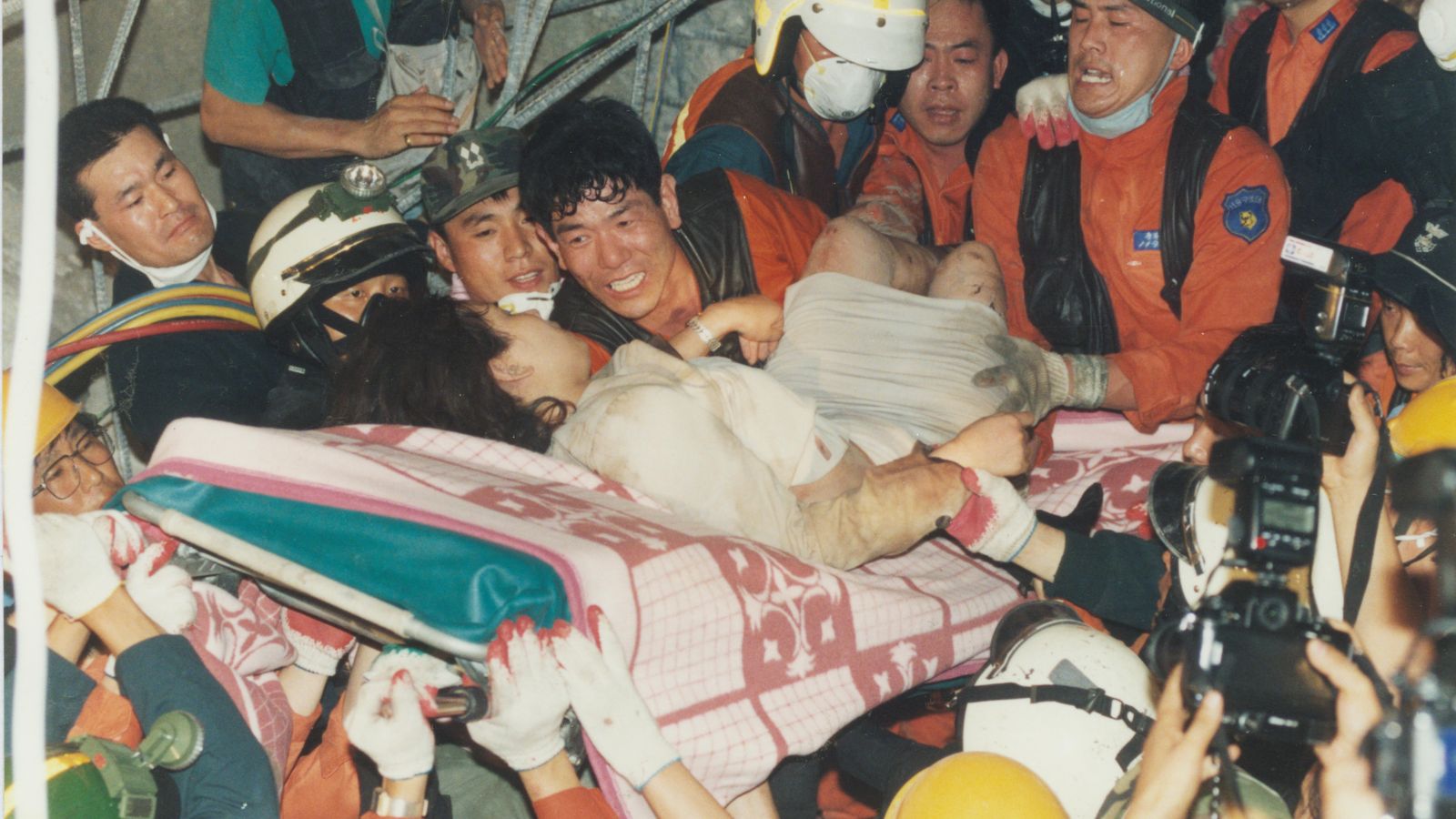
Rescue crews worked for hours trying to locate survivors in the rubble. Hearts sank as the lifeless, mutilated bodies of victims were pulled from the debris. Ever so often, a survivor was found, sparking hope among the crowd gathered nearby. Survivors were transported to nearby medical centers, and soon, hospitals were overwhelmed.
As the hours went by, people became more desperate, screaming the names of their missing friends and relatives. Law enforcement had to prevent the crowd from encroaching on the site.
It was clear that the rescue crew was not prepared for a disaster of this magnitude; they lacked the necessary tools and skills to deal with the situation. Members of the rescue team initially didn’t even have basic tools like flashlights and drills.
One of the emergency responders told the Associated Press that the site of the disaster felt like a garbage dump, explaining that they randomly dug into different spots, hoping to find casualties or survivors.
Although the U.S. military transported sound detectors and other rescue equipment from Hawaii to Seoul to aid in the operation, these tools arrived a little too late. Rescuers also couldn’t use many of these high-tech devices because the area was too noisy and chaotic. The best they could do was depend on Korea Telecom to broadcast a signal every 30 minutes, in hopes of hearing a phone ringing or a pager buzzing in the wreck.
A day after the Sampoong Department Store collapsed, emergency crews started using cranes and other heavy machinery to dig through the rubble. But this didn’t make the task any easier.
To the surprise of many South Koreans, the mayor of Seoul decided to call off the rescue effort shortly after, citing safety concerns for the crew, as what remained of the building could collapse at any moment.
This sparked widespread protests from the angry mob gathered at the scene, with some demanding to be let on the grounds to search for their friends and relatives. The mayor eventually rescinded the decision, and guy-wires were used to stabilize the building for the rescue operation to proceed. But precious time had been lost.
Despite these issues, the team successfully rescued hundreds of people from the ruins of the Sampoong Department Store. Some of these survivors admitted to drinking their own urine to avoid dying of thirst. One survivor said she was so exhausted that she couldn’t even do this.
The last survivor was found in the wreckage 16 days after the building fell. In the end, 502 people died in the accident, and up to 937 others were left with injuries.
In retrospect, the rescue operation could have been handled much differently. Critics say rescuers may have accidentally crushed some survivors to death as they started using heavy equipment at the scene just 24 hours after the accident.
Also, emergency responders were quick to pour water all over the wreckage soon after arriving on the scene. They feared survivors would choke to death from the black smoke billowing from burning cars under the rubble. Survivors later revealed that this water drowned some people. For others, this water and subsequent rains were the lifeline that kept them alive and helped them deal with the sweltering summer heat.
The aftermath of the Sampoong Department Store collapse
When the Sampoong Department Store collapsed, it claimed the lives of hundreds of workers at the store. But none of the store’s executives who visited the building that day were among the dead.
Just days after the building buckled, Lee Joon and his son Lee Han-sang, the CEO of Sampoong Group, were arrested and subsequently charged for their roles in the horrific building collapse. While being interrogated by the police, Lee Joon was reportedly more concerned about the financial implications of the catastrophe than the fate of the victims.
The court found Lee guilty of involuntary manslaughter in December 1995 and sentenced him to ten years and six months in prison. But after an appeal, his sentence was reduced, to the dismay of survivors and grieving relatives of deceased victims. Lee served just seven years and six months in jail. He died in 2003 from health complications after his stint in prison.
Meanwhile, Lee Han-sang was sentenced to seven years in prison for criminal negligence. He finished serving his sentence in 2002 and left the country to become an evangelist in Mongolia following the death of his father.
Several public officials who took bribes to overlook the slapdash construction work at the Sampoong Department Store received varying prison sentences.
In an act of contrition, Lee Joon and Lee Han-sang later donated their wealth to the city of Seoul to compensate victims and their families. Each victim received about $220,000 as compensation. But this hasn’t been enough to assuage the anger of people who lost their friends and relatives or suffered debilitating injuries.
Earlier this year, in an event marking the 30-anniversary of the tragic incident, several relatives of victims admitted they were still living with trauma and anger. “I still cannot go into basements, and I sleep with my doors open,” a woman who lost her husband in the Sampoong collapse, told a local news outlet.
Many survivors and relatives of victims admit they are not satisfied with the meager prison sentences handed to Lee Joon and Lee Han-sang.
A memorial has since been built to honor victims of the Sampoong Department Store collapse. But it’s not at the site of the accident. Instead, the monument is a 30-minute drive away in the Yangjae Citizens’ Forest. Today, you’ll find an upscale apartment complex on the grounds where over 500 people died.
The Sampoong Department Store collapse marked a dark chapter in South Korea’s history. However, it inspired the country to enhance its emergency response planning and implement significant changes to its laws and building safety codes. The revised regulations emphasized the strict enforcement of building safety requirements and imposed harsh penalties for people who violate them.
Following the Sampoong disaster, South Korean authorities conducted a comprehensive inspection of high-rise buildings in the country. They found that only two percent of them met safety standards, necessitating widespread renovation works.
The Sampoong Department Store collapse was not just a tragedy; it was a reckoning. For many developing countries, the incident is a cautionary tale about the dangers of neglecting safety standards in the quest to urbanize quickly.
Although many years have passed and some wounds have healed, the painful memory of the tragedy continues to haunt those who lived through it.
Key Takeaways
- Chairman Lee Joon rejected engineers’ evacuation advice one hour before collapse, prioritizing revenue over 500 lives lost and 900 injured.
- Lee made unauthorized structural changes—thinner columns, wider spacing, misaligned supports, and heavy roof air conditioners—that fatally compromised building integrity.
- Rescue efforts were hampered by lack of equipment, premature heavy machinery use that may have crushed survivors, and water that drowned some victims.
- Lee Joon served only 7.5 years for involuntary manslaughter; victims’ families remain traumatized and dissatisfied with sentences decades later.
- The disaster prompted South Korea to overhaul building safety codes and emergency response, revealing 98% of high-rises previously failed safety standards.
Simon Whistler
Simon Whistler is one of YouTube's most prolific documentary presenters, known for calm, authoritative deep dives into true crime, disappearances, and the world's most enduring unsolved cases. Into the Shadows is his companion archive for the cases he can't stop thinking about.
Frequently Asked Questions
When did the Sampoong Department Store collapse occur?
The Sampoong Department Store collapsed on June 29, 1995.
How many people died and were injured in the Sampoong Department Store collapse?
More than 500 people lost their lives (specifically 502), and over 900 others sustained injuries (up to 937).
Who was Lee Joon and what role did he play in the collapse?
Lee Joon was the chairman of the Sampoong Group’s construction division. He made unauthorized structural changes to the building, rejected engineers’ advice to evacuate the store about an hour before the collapse, and prioritized profit over safety.
What structural changes did Lee Joon demand that compromised the building’s integrity?
Lee Joon demanded adding a fifth floor, creating holes in each floor and removing critical support columns for escalators, reducing column thickness from approximately 35 inches to 24 inches, and increasing the distance between columns to about 35 feet.
Why did Woosung Construction stop working on the project?
Woosung Construction refused to comply with Lee Joon’s requested changes over safety concerns, explaining that these changes would compromise the building’s structural integrity. Lee Joon then terminated their contract.
What was the tipping point that caused cracks to appear in the building?
In 1993, Lee Joon had workers drag three massive air conditioners across the roof on rollers instead of using cranes or a helicopter. The weight of the air conditioners caused cracks to appear in one of the columns on the fifth floor, and vibrations from the air conditioning units widened these cracks over time.
What did engineers recommend about an hour before the collapse, and how did Lee Joon respond?
Engineers told Lee Joon and the board of directors to evacuate the building immediately, warning that it could collapse at any minute. Lee Joon shut down the suggestion, citing the unusually large number of shoppers and potential revenue they stood to gain.
What were some problems with the rescue operation?
Rescue crews lacked necessary tools and skills, initially not even having basic tools like flashlights and drills. High-tech equipment from the U.S. military arrived too late and couldn’t be used due to noise and chaos. The mayor of Seoul briefly called off the rescue effort for safety concerns. Critics say heavy equipment may have crushed some survivors, and water poured on the wreckage to combat smoke may have drowned some people.
What sentences did Lee Joon and Lee Han-sang receive?
Lee Joon was found guilty of involuntary manslaughter and sentenced to ten years and six months in prison, but after an appeal his sentence was reduced and he served seven years and six months. Lee Han-sang was sentenced to seven years in prison for criminal negligence and finished serving his sentence in 2002.
What changes did South Korea make after the Sampoong disaster?
South Korea enhanced its emergency response planning and implemented significant changes to its laws and building safety codes, emphasizing strict enforcement of building safety requirements and imposing harsh penalties for violations. Authorities also conducted a comprehensive inspection of high-rise buildings and found that only two percent met safety standards, necessitating widespread renovation works.
Sources
- Original Into the Shadows video: Sampoong: One of the Deadliest Building Collapses In History
- https://web.archive.org/web/20180815131456/https://www.apnews.com/1876afb73f9de5dd27033cba4bde5050
- Hero image source by 서울특별시 소방재난본부 / openverse, by-sa.