It is the deadliest species of frog in the entire world. One touch of the skin of the poison dart frog and it’s lights out. Do not pass go, do not collect $200 dollars. A chance encounter with one of these banana-coloured harbingers of death can have you pushing up daisies faster than you can say “oh dear,” ensuring you die horribly, and painfully.
But when you delve into the story behind this species, you can see a remarkable symbiosis with humanity that has lasted for untold generations, and that there’s much more to its story than just being pumped full of venom.
So what exactly makes this frog so dangerous to everyone who encounters it? How has humanity harnessed its power for good? And why, if something isn’t done soon, they could become totally extinct?
Key Takeaways
- The golden poison dart frog is the deadliest frog species, with a single frog capable of killing multiple humans or large animals.
- The frog’s toxicity comes from its diet, accumulating poison from insects that have eaten toxic plants.
- Indigenous Emberá people have used the frog’s venom for hunting with blow darts for generations.
- Human activities like logging, mining, and climate change are threatening the frog’s habitat and survival.
- Conservation efforts, including protected reserves and medical research, aim to preserve the species.
All That Glitters
So, what is there to know about the golden poison dart frog, otherwise known by its scientific name, Phyllobates terribilis? Well, it’s an endangered amphibian native to a small rain forested zone on the Pacific coast of Colombia. The humid Chocó forests in the Cauca and Valle del Cauca regions provide the perfect landscape for these little yellow fellas and fell-ettes, with steep rocky terrain, lots of places to hide, and pools of water around for raising young.
They were discovered in 1973, and were first scientifically described in 1978 and placed into the scientific family Dendrobatidae. However, to say they were undiscovered before that point is inaccurate. Indigenous populations local to the area have been living in relative harmony with them for centuries if not longer.
They’re tiny, vibrant-coloured frogs that mostly like to live terrestrially on tree roots or in the leaf litter just above the forest floor where they hunt for their food. They’re insectivores, mainly trying to catch things like flies, crickets, ants, termites, and beetles with its long, extendable tongue.
What else? Well they’re among the largest poison dart frog species, averaging roughly over five centimetres long when fully grown, with females tending to be larger than males. Even despite that they still only end up weighing about 30 grams in weight at their maximum size, which is roughly the weight of a light bulb. But as we’ll soon find out, these little guys pack one hell of a punch.
They’re also diurnal, which means that they are awake mainly during the day, and they live for around 10 years in the wild, but that rises up to 20 years in captivity.
They’re also, as you could likely tell by their name and bright colours, one of the most poisonous creatures in the entire world. And we’re going to dive into why pretty extensively in a bit, but you just need to know that coming into contact with one is a very bad situation for any creature on land, yes, we mean any creature. They can also be pretty grumpy looking, but you’d be grumpy too if you could never hug anything without killing it by mistake.
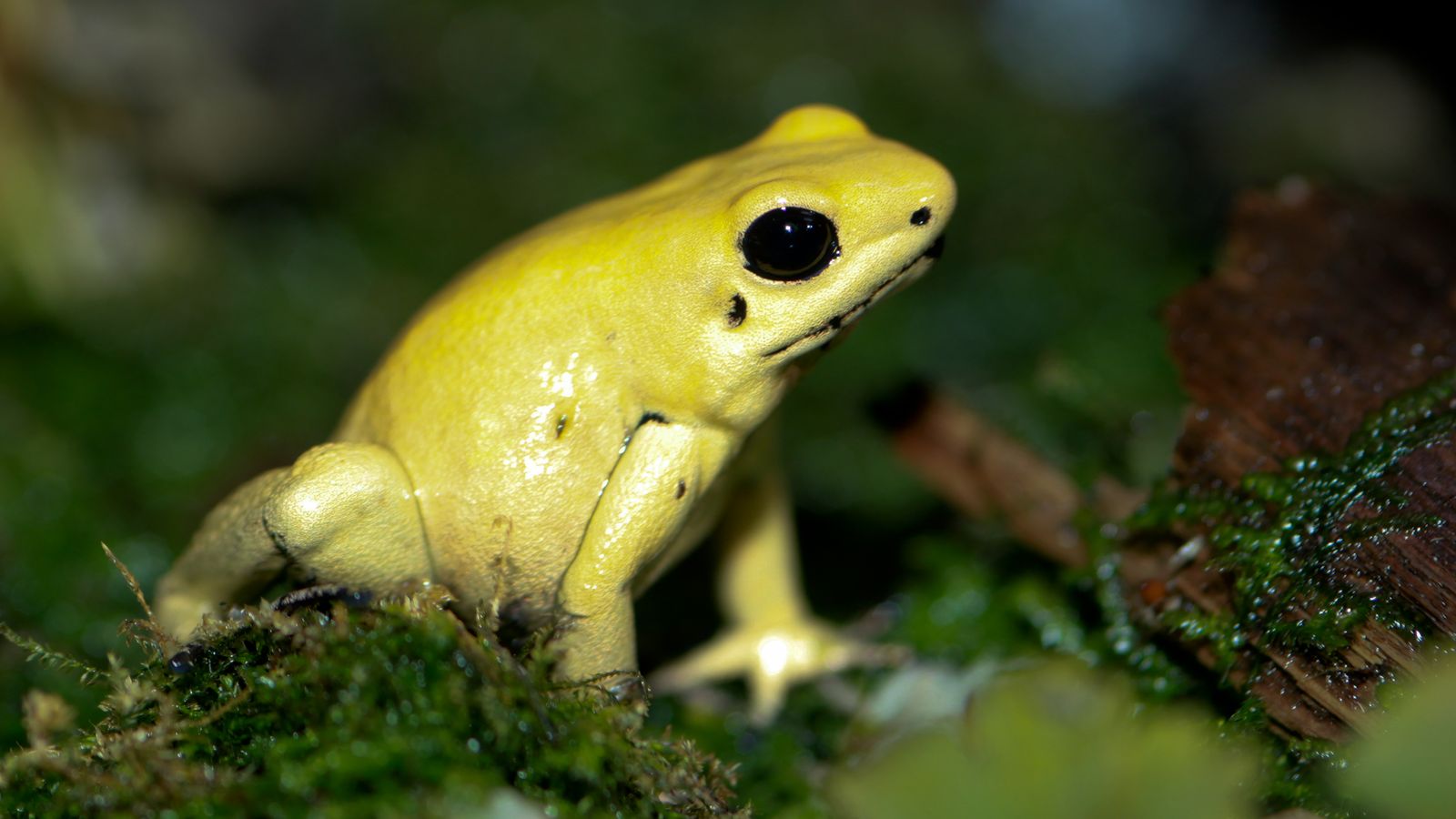
What’s interesting about the golden poison dart frog is that they’re not actually exclusively golden. They run the full pineapple range, from a pale green through to yellow all the way to a golden orange colour, depending on their specific habitat range. But we’re mainly talking about the yellow ones today because they exclusively live in the small Colombian range we mentioned earlier. They have such vibrant colours because they’re incredibly poisonous.
They’re boldly announcing to predators that if they try to eat them, they’ll soon find themselves belly up. This is a tactic called “aposematic colouration.”
They do however have some natural predators, mainly species of birds and snakes that have developed a natural resistance to their poison over time. But other species because of those bold colours will largely leave them alone, leading to staggering appearances of confidence from a frog smaller than a tennis ball. It chooses not to hide when potential predators lurk near (that’s tough enough when you look like a casino’s neon sign anyway) they simply choose to hop away instead. That’s pretty gangster.
They don’t spawn with those colours though. Juvenile frogs are black in colour and have colourful lateral stripes instead, and by 18 weeks as they reach maturity the darker colour and stripes disappear, being replaced by that vibrant deadly yellow we all know and love. This is known as an “ontogenetic colour change.” We’re learning lots of big words today.
But there’s more to these venomous varmints than just being stupidly, ridiculously, unnecessarily dangerous. How they breed is really quite fascinating too, showing complex courtship behaviours unseen in many other species of frog. They’re tactile lovers during reproduction, with male and female frogs stroking their mate’s head, back, flanks, and cloacal areas prior to egg deposition. How romantic.
They find each other through a classic frog trilling, where they rapidly utter high-pitched notes at a rate of 13 per second.
Eggs are then laid on the ground and fertilised, usually in clutches of about 20 usually below the leaf litter where they can remain safe. Then something quite remarkable happens. Frogspawn prefers water so they can continue growing into mature tadpoles, which I’m sure you remember from elementary school biology. The males actually carry the spawn on their backs to permanent pools of water elsewhere in the rainforest, where they will be deposited and left to grow until they mature into juvenile frogs by growing legs and leaving the water.
They tend to feed on algae and mosquito larvae in their nurseries. How neat.
But that’s enough on the basics of these auric amphibians. We’ve already mentioned that they’re one of the deadliest species, not just of frogs, but in general across the world today. So let’s delve deeper into these frogs to really work out just how deadly they are, and how humans have harnessed their power for untold numbers of generations.
A Silent Killer
So, the golden poison dart frog is poisonous, like really poisonous. But just how deadly is it? How much damage can this cute little frog really cause? Well, it turns out, a hell of a lot.
The Golden Poison Dart Frog is considered amongst the most toxic animals on the planet today, and it is the most poisonous frog on earth by some distance, being more toxic than every other species in its genus by around 20 times. Dendrobatids like the Poison Dart Frog are notable for their immense toxicity compared to their relatively small size. They secrete a powerful toxin out of granular glands under its skin that means anything that comes into contact with it can easily become poisoned.
The toxin in question is called batrachotoxin, or in some cases it’s known as homobatrachotoxin. Fun fact, batrachotoxin literally translated into Greek means “frog toxin.” And considering not only frogs actually carry this kind of poison, it goes to show just how infamous these little critters really are.
Batrachotoxin is exceedingly rare in the animal kingdom, with only a handful of animals such as certain species of birds native to Papua New Guinea. Batrachotoxin binds permanently to sodium channels within the body, which means that not only is it super duper deadly, it’s also completely irreversible with no known antidote.
This is exclusively a defensive measure as far as the frog is concerned because it has no method for delivering this poison like via spines, sharp fangs, or saliva. That bright yellow colour is no joke and exists for a reason, because even so much as touching this tiny little amphibian wrong is a good way to get a one-way ticket to the pearly gates.
But how deadly exactly is it? Well a single adult frog of an average size will carry around 1900-2000 micrograms of poison in it at any one time, which is rather a lot. And Batrachotoxin is around 1,000 times deadlier than cyanide. Yeah. It’s that deadly.
This is why the herpetologist Charles W. Myers, and his team of Borys Malkin and biochemist John W. Daly named the frog with its Latin name Terribilis, specifically to warn others about just how fatal a chance encounter with one of these little lemon-coloured critters can really be. That is a unique level of clout in the animal kingdom usually reserved for things like dinosaurs which in Greek translate to “terrible lizard.” I think I’d take my chances with the triceratops if given the choice.
Ok, but what does 1,000 times deadlier than cyanide even look like? For reference that’s enough poison to pop the clogs of around 10 humans, 20,000 mice, or two African Bull Elephants. An average African Bull Elephant weighs somewhere in the region of 4,000 kilograms, and the average poison dart frog weighs somewhere in the region of just 30 grams. That means that this tiny little frog is so toxic that it’s capable of killing something that outweighs it at a ratio of over 13,000 to one. TWICE.
It’s believed that the poison dart frog, much like the Fugu pufferfish, gets its toxicity from accumulating the poison through its diet. Think of it like a poisonous food chain for example. There are plants that have a small amount of toxin in them to ward off irritating little insects and predators.
Some of these insects have evolved something of a minor tolerance to such toxins over millions of years which has given them an evolutionary leg up over other species, and stops them getting eaten by other larger predators because they possess the toxin in larger amounts. And then comes along the Golden Poison Dart Frog looking like a walking banana which has evolved the same tolerance, so it eats the poison insects that ate the poison plants, causing an even larger amount of the toxin to be present within them, and this concentration is what makes them so deadly.
Watch The Project Briefing
Open Video
Video Briefing
Phyllobates Terribilis: The Golden Poison Frog
Scientists theorise that this is the case because of a few factors. For one, the poison isn’t present in tadpoles of the poison dart frog, and juveniles possess it in smaller amounts, meaning that the species isn’t naturally poisonous from birth like the blue-ringed octopus for example, another of the deadliest species on earth. Therefore the toxin has to come from something that the frog is doing in its lifestyle from day to day.
Perhaps it uses Twitter. But it’s more likely to come from its diet, especially as Golden Poison Dart Frogs that are raised in captivity on non-toxic food do not develop the venom over time. Even frogs that are already poisonous adults transferred to captivity see a decrease in their Batrachotoxin levels over time when not fed their favourite poisonous insects.
And as you can tell, these little frogs are so deadly that their venom can be fashioned into poisoned weapons by locals to go hunting with. As you can imagine, given that one of these frogs could take down an elephant, killing prey in the Colombian jungle is a cinch with some patience and a blow dart. But how do they actually do it?
Well, the indigenous Emberá people of Colombia have been using the venom from the frog for decades to put on the tips of their blowgun darts. This is where the species gets its name of course. Most poison dart frogs aren’t actually used for weaponry, but the golden poison dart frog is one of the few that is, alongside other closely related deadly frogs. The term of “poison dart frog” has since come to describe a large family of closely related colourful frogs.
So, to do this, they first have to catch the frogs, which I can only imagine is done extremely carefully with a lot of generational tips and practice. They then expose the frog to heat, such as by placing it near a fire, but not enough to harm it. The heat stimulates the frog to secrete venom, at which point the tip of a blow dart is gently rubbed on the back of the frog.
Once dry, the poison will remain active on the dart for up to a year, so it has to be handled extremely carefully even long after it’s first made. The back of a single frog creates enough poison for two or three darts, which are used to hunt mammals and birds. Of course the hunting process itself is dangerous too, and generations of passed down knowledge allows the Emberá to then cook and eat what they catch without getting poisoned.
The frog is then usually released safely and totally unharmed, but perhaps a bit confused in the same way that someone who had just been abducted by aliens would be.
So, given that the equivalent of two grains of salt is enough to kill a person, these frogs are total death machines and must be avoided at all costs, right? Well yes, but also, no.
The biggest danger of getting poisoned is if any poison at all gets into a cut, scrape or reaches a mucous membrane like the eyes, nose, or mouth. That happens and you’re effectively doomed. The other main danger is from things like secondary transfer. Touching the frog and then accidentally rubbing your eyes, touching a wound, licking your fingers, or even touching food you then ate is how people could potentially fatally poison themselves.
But you’ll know if you touched the toxin because even on unbroken skin it can cause a burning sensation that lasts for hours. It’s about as fun as wiping with a Gympie-Gympie tree.
Ok, but how does it actually kill you? Well we mentioned that batrachotoxin binds to sodium channels in the body. But what does that really mean? Well your brain sends signals to the muscles in your body using electrical signals through sodium channels which open when they receive a signal, and then close again so they can reset and wait for the next signal.
Batrachotoxin jams those sodium channels permanently open, which stops the brain from being able to transmit impulses to the body’s muscles because those sodium channels can’t reset. This causes a quick and spreading paralysis across your body that would start with tingling, weakness, and numbness. But soon you’d stop being able to breathe and your heart would start to beat erratically.
Smaller doses are known to cause seizures, excessive salivation, muscle contractions and difficulty breathing, but death usually comes as a result of a cardiac arrest, commonly known as a heart attack, within mere minutes. It’s a painful and terrifying way to go, with barely enough time to even say goodbye.
Now, given all of that you would assume that people are just dropping left and right from this tiny deadly Dendrobatid, right? Well actually, there are no currently known documented and verified cases of death by golden poison dart frog in scientific or medical literature. They’re already endangered and found deep in the remote Colombian jungle amongst people with no written records and far away from any medical facilities. If people have died from it, which is distinctly likely given how dangerous it is, knowledge of it would remain as part of the oral history within the communities in which the death happened.
What is documented though is several cases of chickens and dogs, who died after coming into contact with paper towels where the frog had previously stood on hours beforehand. Such cases have helped us understand the extreme potency of the dart frog’s venom.
Paradoxically, the golden poison dart frog is so dangerous and we’re so acutely aware of its danger that it’s known to be avoided at all costs, which somewhat eliminates the risks. And believe it or not, we are more dangerous to them than they are to us.
A Future in Doubt?
Yes, that’s right. Humans are far deadlier for golden poison dart frogs than the other way around. And that’s because of our old friends, human intervention, and climate change.
These frogs are endangered for a reason after all, and human practices ensure that the trend is going in the decidedly wrong direction (or the right direction if you wish for them to go extinct, I guess.)
They already live in a pretty small range and specific habitat on the Pacific Coast of Colombia, and despite them being relatively common in that small range, it’s only getting smaller as the forest and jungle is decimated by human practices.
You’ve of course got things like logging which has threatened their habitat for many years. But also mining for things like gold and energy resources also damage the landscape and poison water supplies that these frogs rely on. Meanwhile the planting of crops in local areas, and larger areas of the forest being slashed and burned to make way for agriculture have their detrimental effects.
Pollution from spraying crops with pesticides has also been known to kill them. Yes, humans are so terrible that we successfully manage to poison the most poisonous frog in the world. The small area it lives in makes it vulnerable to wholesale changes that arise from climate change.
Its habitat is one of the wettest forests in all of Colombia, and adverse weather events, and otherwise disrupted weather patterns that are becoming increasingly common makes them even more vulnerable. And unfortunately, they are also trafficked in the international illegal pet trade to places like Asia, which risks people getting killed by them and further decreases the natural population, whilst threatening to make the most dangerous frog in the world an invasive species. That’s not really the solution you want to the whole endangered thing.
But it’s not all bad, whilst this endangered little amphibian does face significant challenges, humanity are doing what they can to help in ways that will hopefully preserve the species for many years to come.
For starters, the World Land Trust has helped to create the Rana Terribilis Amphibian Reserve, specifically to protect this frog and its habitat which is valuable in and of itself. Whilst the habitat was totally unprotected until 2012, the reserve was created with the help of Colombian environmental NGOs. These organisations have stumped up the funds to pay for wildlife rangers to patrol the reserve and monitor the land, which in theory will stop, or at least slow the prevalence of illegal logging, mining, and hunting that could adversely affect the golden poison dart frog. And if the worst does happen, a breeding colony of 18 frogs has been established at the American Museum of Natural History, so even if their habitat was made completely unliveable, the species itself will be able to live on to hopefully be reintegrated back into the wild.
And in the most human way possible, one way to ensure the prolonged preservation of the species is for them to provide some utility for mankind, which researchers are beginning to discover. The medical research community has been exploring possible medicinal uses for the frog’s toxins, and has already developed a synthetic version of one of the poison’s compounds that has potential to be a powerful painkiller.
And they’ve even found their way into popular culture too with their vibrant colours and deadly reputation. A frog resembling the golden poison dart frog was depicted in the Mel Gibson movie, Apocalypto even utilising the same technique of rubbing a dart on the frog’s back to make it deadly. However it’s worth stating that the frog depicted in the movie is way too large to be an actual poison dart frog and so they likely got a larger yellow one for a bit of movie magic. That’s Hollywood for you; they’ve always had a flexible relationship with the truth.
So, ultimately, this frog’s story walks very much in lockstep with our own as a species. Perhaps more now than ever. From the indigenous communities who have used its special properties to hunt for generations, to the advanced medical science of tomorrow and the effects we have on it as a species even if you never even see one in your entire life.
But despite how nominally dangerous the golden poison dart frog is, it shouldn’t be something to fear, but it deserves to be respected just like the rest of the natural world which we’re rapidly changing for the worse every year. Because the real fatal mistake, and the main thing to truly be afraid of when it comes to this frog, is what happens when it disappears from our earth forever.
Key Takeaways
- The golden poison dart frog is the deadliest frog species, with a single frog capable of killing multiple humans or large animals.
- The frog’s toxicity comes from its diet, accumulating poison from insects that have eaten toxic plants.
- Indigenous Emberá people have used the frog’s venom for hunting with blow darts for generations.
- Human activities like logging, mining, and climate change are threatening the frog’s habitat and survival.
- Conservation efforts, including protected reserves and medical research, aim to preserve the species.

Simon Whistler
Simon Whistler is one of YouTube's most prolific documentary presenters, known for calm, authoritative deep dives into true crime, disappearances, and the world's most enduring unsolved cases. Into the Shadows is his companion archive for the cases he can't stop thinking about.
Frequently Asked Questions
What is the scientific name of the golden poison dart frog?
The scientific name of the golden poison dart frog is Phyllobates terribilis.
Where is the golden poison dart frog native to?
The golden poison dart frog is native to a small rainforested zone on the Pacific coast of Colombia, specifically in the Chocó forests in the Cauca and Valle del Cauca regions.
How long do golden poison dart frogs live?
Golden poison dart frogs live for around 10 years in the wild, but up to 20 years in captivity.
What do golden poison dart frogs eat?
Golden poison dart frogs are insectivores and mainly eat flies, crickets, ants, termites, and beetles.
How does the golden poison dart frog’s color change as it matures?
Juvenile golden poison dart frogs are black with colorful lateral stripes. By 18 weeks, as they reach maturity, the darker color and stripes disappear, being replaced by a vibrant deadly yellow.
What is the primary toxin produced by the golden poison dart frog?
The primary toxin produced by the golden poison dart frog is batrachotoxin, which is extremely rare in the animal kingdom.
How do indigenous people use the golden poison dart frog for hunting?
The indigenous Emberá people of Colombia use the venom from the golden poison dart frog to coat the tips of their blowgun darts for hunting mammals and birds.
What are the main threats to the golden poison dart frog’s habitat?
The main threats to the golden poison dart frog’s habitat include logging, mining, agriculture, pollution from pesticides, and climate change.
What efforts are being made to protect the golden poison dart frog?
The World Land Trust has helped create the Rana Terribilis Amphibian Reserve to protect the golden poison dart frog and its habitat. Additionally, a breeding colony has been established at the American Museum of Natural History.
What potential medical uses are being explored for the golden poison dart frog’s toxins?
Researchers are exploring the potential medicinal uses of the golden poison dart frog’s toxins, including developing a synthetic version of one of the poison’s compounds that could be a powerful painkiller.
Sources
- Original Into the Shadows video: Phyllobates Terribilis: The Golden Poison Frog
- Hero image source by Brian Gratwicke / openverse, by.