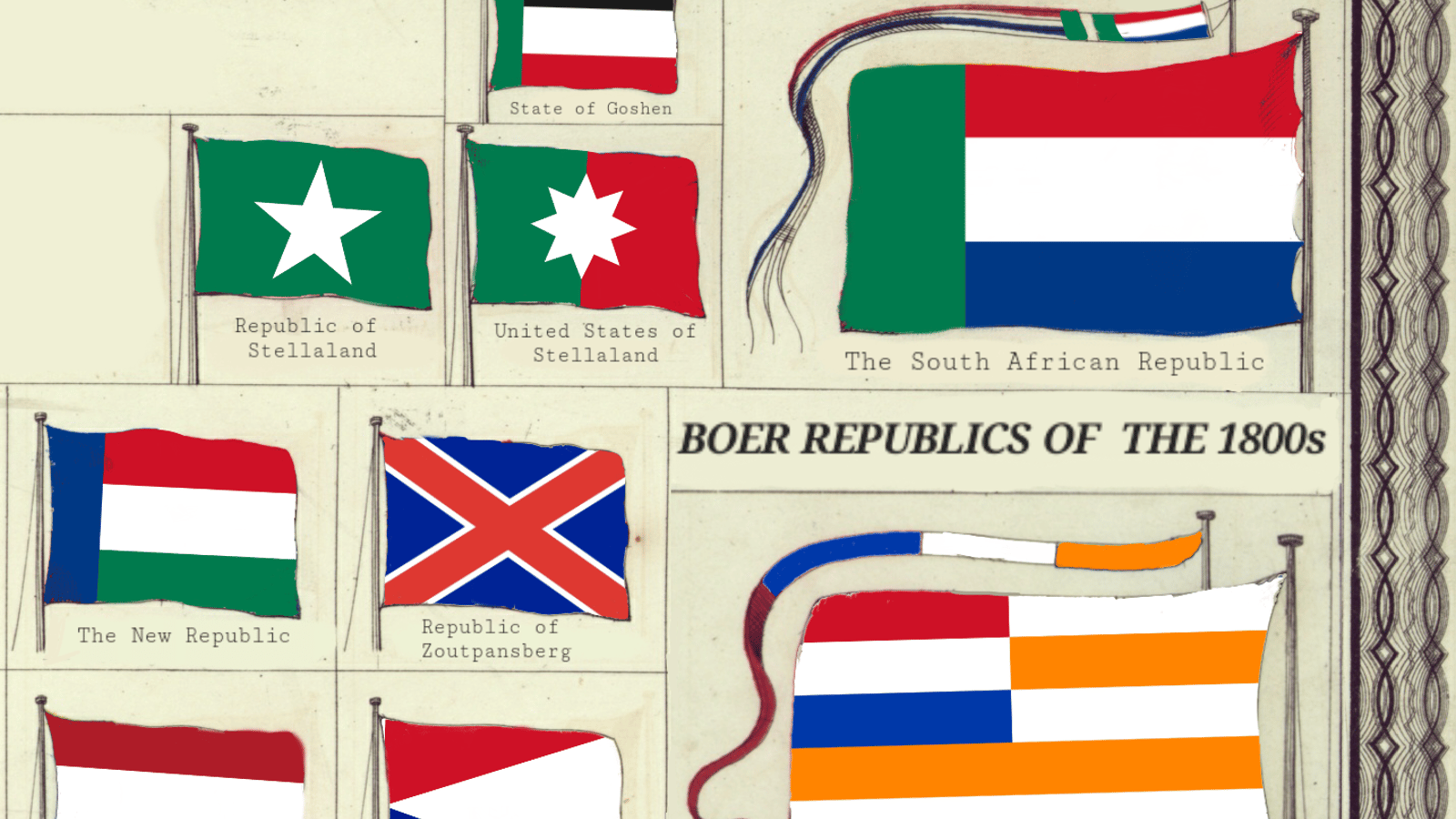
Between the 11th of October 1899 and the 31st of May 1902, the British Empire waged a war against the South African Republic and its neighbour, the Orange Free State. According to some sources, the British Empire’s goal was to unite the British-ruled Cape and Natal Colonies with the two Boer republics of the Orange Free State and the South African Republic (or Transvaal). The second reason was to bring an end to the ‘Outlander’ policies of the Boer Republics, which stated that ‘foreigners’ from North America and European countries weren’t allowed to buy property, settle in the Boer Republics, or take part in local elections unless they were ‘white’, had been residing in the Boer republics for a minimum of 14 years or were younger than 40 years of age.
But according to Lord Salisbury, the then UK Prime Minister, they were also concerned with the way in which the Boer Republics treated its black citizens, stating that the war was really fought – “in the interest of [preventing] slavery.” And they might have had a point since the South African Republic’s constitution proudly claimed that –
“The People are not prepared to allow any equality of the non-white with the white inhabitants, either in Church or State.”
Key Takeaways
- The Second Boer War (1899-1902) was fought to unite British colonies with Boer republics.
- Post-war, British mining companies struggled to find skilled labor for gold mines.
- The Chamber of Mines imported 63,395 Chinese laborers between 1904 and 1907.
- Chinese laborers faced harsh working conditions and restrictive living arrangements.
- Public outcry and political pressure led to the end of Chinese labor importation in 1906.
But the South African Republic’s governing body, the Volksraad (or People’s Council), was convinced that the British were only interested in taking control of Johannesburg’s rich gold mines - especially since the discovery of diamonds in Kimberley in the Orange Free State had led to the annexation of the diamond mines by the British Empire back in 1871, which had resulted in the First Boer War.
Then the Second Boer War broke out in October 1899, and in just 7 months, the South African Republic lost control of the fledgling city of Johannesburg and its 55 gold mines. When the war came to an end in May 1902, the mines were reopened, but the British mining companies had trouble finding experienced mine workers to extract the valuable gold ore. The white mine workers had left the city to help rebuild the country, and those who were willing to work in the mines were unskilled and demanded higher wages than the mining companies were willing to pay. Black South Africans were the preferred and cheaper option, but the 120 000 black skilled mineworkers had returned to their villages and families after the war broke out and were reluctant to take up their pickaxes and work for menial wages again.
Due to the lack of a skilled workforce, the mines were struggling to live up to their pre-war reputation as the ‘world’s largest single producer of gold’, so Johannesburg’s Chamber of Mines ordered that a new supply of skilled labour should be found. Initially, they tried to tempt black labourers from South Africa’s neighbouring countries to work in the gold mines, but when they refused, the mining companies turned their attention to other sources of cheap labour – California, British Columbia, the East Indies, and China.
The Decision to Import Chinese Labour
In September 1903, Ross Skinner, a member of the Chamber of Mines’ Select Committee, presented a report to Johannesburg’s Board of the Chamber of Mines and explained that he’d investigated the ‘suitability’ of labourers who could be imported from Korea, Japan, and China and that he’d come to the conclusion that Chinese labourers would be the best investment. However, he noted that if the Chamber of Mines did decide to import Chinese indentured labourers, they should consider the fact that the Americans had grown increasingly unhappy with the high number of previously indentured Chinese who had now settled in California, and suggested that the Transvaal government should implement strict laws to control the movement of these Chinese labourers before they were allowed to set foot on South African soil.
At the time, groups of indentured Chinese labourers had already been working in several households in the Cape and Natal colonies for over 200 years – mostly as cooks, gardeners, carpenters, and construction workers, but also as cheap labour on British-owned farms and sugar plantations. At the end of the 17th century, at least 100 Chinese indentured workers had been brought over to the Cape Colony, and by the end of the 19th century, there were 77 Chinese living in Natal, 215 living in the Cape Colony, and at least 900 already living in the Transvaal.
Initially, they were often victims of the ‘Coolie Trade’ or human trafficking – with some sources explaining that some of these Chinese indentured workers often ended up settling down in the Colonies and having families in their new countries because returning to Imperial China and its anti-emigration laws would result in their execution. That is until the growing demand for cheap labour in the West had the British and Americans pressuring the Imperial Chinese authorities into agreeing to ‘loan’ some of their citizens out to the West as indentured labourers.
According to a memorandum by John X. Merriman, the British Commissioner of the Ministerial Department of Crown Lands and Public Works in 1874, the goal of importing these Chinese indentured labourers had been to –
“…create and [maintain] a class of cheap labourers, who will thankfully accept the position of [servant], and not be troubled with the inconvenient ambition of bettering their condition.”
The Chinese were considered to be especially suited to the role of ‘servant’ because –
“[They are a] industrious, saving, sober, peaceful people; and they succeed in making a livelihood, and even in acquiring what is to them wealth, where an Englishman would starve.”
Anti-Chinese Sentiment in the Colonies
That’s not to say that these Chinese emigrants were welcomed in their new country, and their cultures and traditions were so unlike the Western traditions of the European settlers in both the Cape Colony and Natal that the latter felt ‘threatened’ by them. In 1875, a local newspaper, the Natal Mercury, described the local Chinese merchants as ‘aggressive and acquisitive’, with one article from 1881 explaining that –
“Excepting in the most infinitesimal numbers [the Chinese] must act as a drawback to the prosperity of any European colony. The Chinaman is insidiously working his way into Natal, and our police court reports are already beginning to tell of a dozen of the pigtail wearers being fined for gambling on a Sunday morning.”
By 1893, more than 5 000 Natal residents protested against the growing Asiatic population in Natal, which led to the Natal Government drawing up the Immigration Restriction Act of 1897 which allowed the government to deny Chinese emigrants entry into the colony, with the Cape Colony following suit in 1902. The Boer colonies weren’t far behind, and while the Chinese were allowed to live in both the Orange Free State and Transvaal, they were prohibited from becoming citizens, had to register themselves with a local magistrate within 8 days of their arrival in the colony, and weren’t allowed to obtain gold prospector licences during the gold rush.
Following the end of the Second Boer War in 1902, at least 938 Chinese emigrants returned to their homes in the Transvaal, but under the new British government, they were now subject to discriminatory laws like not being allowed to walk on sidewalks, standing under verandas, take taxis, and they were only allowed to ride in the 3rd class compartments whenever they boarded a train. They also had to fight for their right to continue to own and manage their own businesses, which led to them establishing the Transvaal Chinese Association, or TCA, which helped to ‘protect the interests of its members’ and ‘offered assistance in dealing with official channels and translating documents from English and Chinese.’ The new administration was also enforcing immigration laws that stated that Chinese emigrants couldn’t enter the country if they couldn’t read or write English, weren’t allowed to bring their families over, and those who were already living in the Transvaal were still being denied citizenship and had to pay an annual amount of £25 if they didn’t want to be deported.
The Chamber of Mines’ ‘Experiment’
Of course, now the Chamber of Mines wanted to import thousands of indentured Chinese workers into the country, and they faced opposition from the public, local trade unions, and the Chinese merchants who were already living in the city. These Chinese merchants especially did their best to discourage any Chinese citizens who might decide to move to the Transvaal to work in the mines, and they sent letters to Chinese newspapers to highlight the dangers these indentured labourers would face. One such article that was published in the south of China explained that –
“Nowadays the Chinese are poor and it is hard to get a living. On hearing that labourers are required for the gold mine many will avail themselves of the opportunity. If one got into the trap it is as entering into a living hell. Should he escape from being a ghost in the foreign land and finally return as survivor, it would be but a rare case. We, living in Africa ourselves, cannot bear to see the tragedy done to our race…”
“These mines here are of a rocky nature running several hundred feet deep in the ground. Explosives have to be used to split up the rocks and when any explosions take place it sounds as if it were thundering and earthquake. It is not uncommon to see poor [black workers] while working in the cave are thus blown to death. Some losing their arms and feet and some with heads scald(ed) and burnt.
The [blacks] are sometimes forced to work in the cave where the water never ceases to run and their feet thus immersed in the water for nights and days. Such hardships are unbearable even by oxen and horses. How is it possible for the Chinese to endure it?”
But the new British authorities in the Transvaal needed the gold mines to turn profitable again, so they turned a blind eye and allowed the Chamber of Commerce to do whatever it took to convince the public that they had no choice but to import cheap Chinese labour to work the gold mines. They explained that the importation of cheap labour wasn’t intended to be a permanent solution. Instead, it would be an ‘experiment’, and the Chamber of Mines and the British administration would ensure that it was conducted in the best interest of the Transvaal’s white citizens.
These Chinese labourers would live in compounds on mine property, their movements would be restricted, they’d only receive minimum wage, and once their three-year contracts were up, they would be sent back to China. If they refused to work, went MIA, tried to find employment elsewhere, or were caught conducting a business, they would be charged with criminal offences and could be imprisoned or deported back to China.
The Chamber of Mines also set aside certain positions that would only be filled by skilled, white workers such as plumbers, electricians, mechanics, masons, blacksmiths and bricklayers. They would also appoint Superintendents to oversee the Chinese labourers and to keep track of them.
The British administration also established the Foreign Labour Department to deal with the Chinese Government, who had their own requirements regarding how its citizens would be treated. They insisted that agents of the Chinese government should be allowed to conduct inspections of the compound, and explained that the mining authorities would not be allowed to use corporal punishment on its citizens. They also stipulated that a Consul-General should be appointed to oversee the interests of all the Chinese citizens who lived in the Transvaal, and the first Consul-General, Lew Yuk Lin, arrived in Johannesburg on the 14th of May 1904.
Arrival and Living Conditions
Between May 1904 and March 1907, 63 395 Chinese labourers arrived in South Africa. The majority of them came from northern China, and all of them were contracted to work in the mines for three years. Once they arrived in Durban, they underwent a medical examination, after which they were sent to Jacob’s Camp, a former British concentration camp located outside of Durban.
Once there, their fingerprints were taken, and they were given brass badges which listed their name and the name of their employer. They were then sent by train to the Transvaal, where they would start working in one of the 55 gold mines that stretched from Randfontein in the West Rand, to Springs in the East Rand.
The labourers were housed in prison-like compounds, and up to 40 of them had to share a room. According to an article in The Star on the 14th of January 1975 –
“The Chinese miners [working at the Simmer and Jack mines] were subjected to grim living conditions if the Simmer and Jack bunk room is anything to go by. The bunks are 61 cm wide and 2,1 m long. They are in rows of 10s with the top layer a little over 91,5 cm above the lower one.”
Watch The Project Briefing
Open Video
Video Briefing
The Indentured Chinese Who Worked in South Africa's Gold Mines
Their diet consisted out of a daily allowance of rice, meat, vegetables, tea, nut oil and salt to prepare their food with. They had to share a communal bathroom, and their latrines were located outside to make it easier to clean. They had easy access to both Western and Chinese doctors and medicine but ate, slept, and lived on the compound, and were only allowed to leave the compound if they’d managed to receive a permit that allowed them to do so. Sundays were their days off, and the lucky few could be seen riding around the city on bicycles while they did some shopping or went sightseeing.
For those stuck on the compound, the mines arranged sports days between their black and Chinese labourers. The Chinese labourers also entertained themselves by staging elaborate theatre productions, and on Chinese public holidays like Chinese New Year, the Chinese labourers would be allowed to visit other mines so they could attend these productions. They were closely monitored by English-speaking Chinese ‘policemen’ who were responsible for ensuring that the labourers didn’t indulge in un-Christian-like vices like drinking alcohol, smoke opium, or gamble, but these policemen were easily bribed, and the majority of the labourers’ free time was spent gambling and drinking to their heart’s content.
Harsh Working Conditions and Abuse
But while it sounds like fun and games, their working conditions were harsh. The Chinese labourers were often put to work excavating the richest ore veins, which meant working underground for long hours. Their lack of experience also meant that they were easily injured, and in October 1905, a compound manager, Eugenio Bianchini, explained that –
“It happens sometimes that [the Chinese labourers aren’t] physically strong enough to perform satisfactorily the work given to him, but simply because [he] was, irrespective of his ability, allotted to a certain boss, he has to remain with him; and without consideration to his physique he has at times to perform a job which may be perhaps beyond his natural power to do.”
This led to a number of accidents taking place in the mines, and between 1904 and 1910, 611 Chinese labourers became disabled, and an estimated 3 192 of them died. Some of these deaths were caused by the miners ‘jumping into moving cages, drilling into unexploded charges and not knowing how to use explosives. Occupational hazards of mine work included such incidents as the snapping of cage-ropes, which occurred on the Simmer East mine and killed 23 Chinese.’ Other causes of death included tuberculosis, Vitamin B1 deficiencies, dysentery, opium poisoning, suicide, and murder.
And despite the Chinese government’s insistence that its citizens shouldn’t be punished using corporal punishment, that is exactly what happened. According to a British newspaper called Morning Leader, the Chinese labourers who committed minor offences were often flogged instead of being allowed to stand trial, since it was considered to be too costly and was a method of punishment that the Chinese would easily understand. They further explained that the other methods of punishment included:
- Being stripped of their clothes and tied to poles by the long braids or queues that were fashionable at the time,
- Having their left hand hoisted up into the air so that they had to stand on tip-toe for hours on end, and
- Being tied to a horizontal beam that forced them to squat or bend over.
Mass Desertion and Violent Response
Some of the crimes they were charged with included common assault, forgery, theft, housebreaking, public violence, and murder, but within a year of their arrival, an estimated 21 205 cases of desertion were reported – which was almost half of the entire Chinese labour force at the time. When the Superintendent of the Foreign Labour Department was questioned about this high number of deserters, he attributed it to the Chinese labourers’ love of gambling and smoking opium, explaining that they were prone to borrow heavily from each other, and then fled the compound to avoid repaying their debts.
But of course, it wasn’t as simple as that –
“Some Chinese labourers were so homesick or hated their conditions so much that they fell prey to charlatans in their midst. At one mine a wily labourer set himself up as a ‘geographer’, selling maps which ostensibly outlined the route back to China, via Tibet.”
“There was also the case of a deserter from the Angelo Gold Mine who claimed to want to walk back to China. Arrested and charged with attempting to break into a house in Germiston, he told a court that he had left the mine with the intention of returning to China. He denied trying to enter any house and said he thought that if he followed the railway line he would ‘get to China by and bye’. He was sentenced to two months imprisonment.”
The residents of the Transvaal had already been wary of the idea that tens of thousands of Chinese would be moving to Johannesburg to work on the mines, and when news broke that over twenty thousand of them had escaped within the first year, tensions rose, with newspapers highlighting the so-called ‘dangers’ these escapees posed to the public. These reports prompted Lord Selborne, the High Commissioner of South Africa, to declare that if the white citizens of the Transvaal were to come across these Chinese deserters, they were allowed to shoot them on sight, and -
“Any white man will be empowered to arrest without warrant any Chinese labourer found outside Witwatersrand district, and to hand him over to nearest Police Station. He will be refunded reasonable expense incurred in doing so.”
And if that wasn’t bad enough, he continued to explain that if you couldn’t afford a gun to hunt down these errant Chinese, you just had to apply and the Government and your local magistrate would happily supply you with one.
International Outcry and Political Fallout
Not surprisingly, this little ‘experiment’ that the Chamber of Mines and the British administration were conducting was going rather badly, and public outcry against their treatment of the Chinese labourers spanned international borders.
Back when the decision to import 65 000 Chinese labourers was first made back in 1902, British trade unions protested against the decision by referring to it as amounting to “Chinese Slavery”. On the 24th of March 1904, 80 000 people gathered in Hyde Park to protest against the decision to import cheap Chinese labour into South Africa, with the Parliamentary Committee of the Trade Union Congress declaring that –
“…this meeting consisting of all classes of citizens of London, emphatically protests against the action of the Government in granting permission to import into South Africa indentured Chinese labour under conditions of slavery, and calls upon them to protect this new colony from the greed of capitalists and the Empire from degradation.”
When British newspapers reported on the agreements that had been made between the South African Foreign Labour Department and the Chinese government, the conditions that the Chinese labourers would be forced to live and work in were described as being “unfit for human beings”, and commentators explained that it was clear that the mining magnates and British administration in South Africa only saw the Chinese labourers as “mere chattel or animated pickaxes”.
And when the British general elections took place in January 1906, the British Liberal Party and the Labour Party used the public outcry to their advantage. They pointed out that it had been the governing Conservative Party’s decision to agree to the importation of these 65 000 Chinese Labourers, and then highlighted the truly inhumane treatment that the Chinese in the Transvaal were subject to, explaining that they were being treated like slaves and that it was the Liberal and Labour Party’s mission to bring an immediate end to the importation of Chinese indentured labourers.
They also pointed out that the British public had been against the decision to import Chinese indentured labourers from the beginning by stating that -
“…the working man - and indeed the soldiers who had fought in South Africa [during the Second Boer War] - felt not only threatened but cheated. They had been promised South Africa as a new field for increased British employment, but saw - with the introduction of foreign workers - the percentage of British employed in the mines actually decrease…”
End of the ‘Chinese Experiment’
And just like that, the Conservative Party was ousted, and the recruitment of Chinese labour was stopped in December 1906. Back in the Transvaal things weren’t going much better. They were granted the right to govern themselves, and in the February 1907 general elections, the Het Volk party campaigned against the importation of Chinese labourers and demanded their repatriation back to China. The white Afrikaners and the British citizens of the Transvaal joined forces and elected the Het Volk party into power, and the decision was made to start the repatriation process as and when the Chinese labourers’ contracts expired.
Notices were put up all over the mines to inform the Chinese labourers that they had the option to apply for repatriation before their contracts expired – an offer just 830 of them accepted. Of course, you can’t please everyone, and some had wished that the Chinese labourers would be allowed to stay – most notably the mining and trade industries, who pointed out that the “Chinese Experiment” had been successful, and that the mines were once again just as productive and profitable as they had been before the war broke out. They also pointed out that they were now losing a skilled workforce, who could be described as being –
“…docile, industrious, and, as the comparative criminal statistics have shown, law-abiding workers.”
And they weren’t the only ones, since thousands of the Chinese labourers submitted requests and petitions, begging the Foreign Labour Department to allow them to stay. At least 118 of them left their compounds to avoid being repatriated and returned to the mines a few weeks later to apply for new jobs in the mines, leading to their capture. In May 1909, the remaining Chinese labourers were warned that if they were caught, they would either be fined or imprisoned for three months.
In February 1910, the last ship left for China, and over the next few years, the new Union of South Africa felt the absence of their departure. Out of the 73 gold mines that were producing gold in 1908, just 63 were still operational at the end of 1910. Black labourers who had started to return to the mines in 1906 were now being paid the same wages the Chinese labourers had received – which was less than they’d earned before the war broke out – and many of the control measures that had been put in place to keep the Chinese labourers from ‘stealing’ the jobs of skilled white workers, continued to be in effect until Apartheid ended in 1994.
Lasting Legacy
Anti-Asiatic legislation was still in effect and continued to impact the 2 300 Chinese who’d already been living in South Africa until at least 1933, and negative opinions regarding the Chinese severely limited the growth of the Chinese community in South Africa for the next century.
According to Melanie Yap and Dianne Leong Man, the authors of the book “Colour, Confusion and Concessions: The History of the Chinese in South Africa” -
“The mass importation of labour was a short-lived episode in the story of the Chinese in South Africa. They came, they made their presence felt and then they left … all within the space of six years… That they made an indelible impression is undeniable and stories of their exploits continue to be passed from one generation to the next.”
Key Takeaways
- The Second Boer War (1899-1902) was fought to unite British colonies with Boer republics.
- Post-war, British mining companies struggled to find skilled labor for gold mines.
- The Chamber of Mines imported 63,395 Chinese laborers between 1904 and 1907.
- Chinese laborers faced harsh working conditions and restrictive living arrangements.
- Public outcry and political pressure led to the end of Chinese labor importation in 1906.

Simon Whistler
Simon Whistler is one of YouTube's most prolific documentary presenters, known for calm, authoritative deep dives into true crime, disappearances, and the world's most enduring unsolved cases. Into the Shadows is his companion archive for the cases he can't stop thinking about.
Frequently Asked Questions
When did the British Empire wage war against the South African Republic and the Orange Free State?
Between the 11th of October 1899 and the 31st of May 1902.
What was one of the reasons for the British Empire’s war against the South African Republic and the Orange Free State?
To unite the British-ruled Cape and Natal Colonies with the two Boer republics of the Orange Free State and the South African Republic (or Transvaal).
What was the ‘Outlander’ policy of the Boer Republics?
A policy that stated that ‘foreigners’ from North America and European countries weren’t allowed to buy property, settle in the Boer Republics, or take part in local elections unless they were ‘white’, had been residing in the Boer republics for a minimum of 14 years or were younger than 40 years of age.
Why did the British mining companies struggle to find workers after the Second Boer War?
The white mine workers had left the city to help rebuild the country, and black skilled mineworkers had returned to their villages and were reluctant to take up their pickaxes and work for menial wages again.
What was the ‘Chinese Experiment’?
The importation of 65,000 indentured Chinese laborers to work in South Africa’s gold mines between 1904 and 1907.
What were the living conditions like for the Chinese laborers in the mines?
The Chinese laborers were housed in prison-like compounds, with up to 40 sharing a room. Their diet consisted of rice, meat, vegetables, tea, nut oil, and salt. They had access to doctors and medicine but were restricted in their movements and had to share communal bathrooms and latrines.
How many Chinese laborers died between 1904 and 1910?
An estimated 3,192 Chinese laborers died due to various causes including accidents, tuberculosis, Vitamin B1 deficiencies, dysentery, opium poisoning, suicide, and murder.
What was the public and international reaction to the treatment of Chinese laborers?
There was significant public outcry and international protest against the inhumane treatment of the Chinese laborers, with comparisons made to slavery. British trade unions and political parties used the issue to gain support, leading to the stoppage of Chinese labor recruitment in December 1906.
What happened to the Chinese laborers after their contracts expired?
The majority of the Chinese laborers were repatriated back to China. Only 830 chose to apply for repatriation before their contracts expired, and many others tried to avoid repatriation by hiding or seeking new employment.
How did the repatriation of Chinese laborers affect the gold mines?
The repatriation led to a decrease in the number of operational gold mines and a loss of skilled labor. Black laborers who returned to the mines were paid lower wages, and many control measures remained in effect until the end of Apartheid in 1994.
Sources
- Original Into the Shadows video: The Indentured Chinese Who Worked in South Africa’s Gold Mines
- Hero image source by M J Hurter / openverse, by-sa.