For much of Papua New Guinea, daily life has been a relentless nightmare for decades. For men, something as routine as a shopping trip or a walk in the park can end in a mugging, a carjacking, or a savage beating for no reason at all. For women, the situation is even worse; a simple walk outside isn’t even an option for those who wish to avoid a gruesome fate. The root of this chaos?
A widespread network of gangs known as the Raskols. For years, these violent groups have terrorized communities across PNG with little to no interference from the police. They rob, assault, and terrorize at will, effectively ruling their neighborhoods like local warlords. In this exploration, we’ll dive into the world of the Raskols, a gang whose initiation rituals are among the most brutal in history, and examine how, despite their brutality, they’ve managed to thrive for decades.
Foundations
To understand the world that gave rise to the Raskols, one must first understand Papua New Guinea as a country. Located just north of Australia, the island of New Guinea is as rugged in terrain as it is in history. Today, the island is split between two nations: Papua New Guinea in the east and Indonesia in the west. But this division doesn’t imply a small nation as Papua New Guinea alone is nearly twice the size of the United Kingdom.
Key Takeaways
- Papua New Guinea’s Raskol gangs have terrorized communities for decades, with little police intervention.
- Raskol initiation rituals involve brutal acts like rape, reflecting the gangs’ deeply violent culture.
- The Raskols’ control extends to influencing corrupt police and government officials, making law enforcement ineffective.
- Women in PNG face extreme violence, including rape and witchcraft accusations, with limited legal recourse.
- Despite some anti-corruption efforts, Raskol gangs continue to dominate cities, committing atrocities with impunity.
Despite its size, the island’s harsh geography, complete with dense jungles, towering mountains, and treacherous river valleys, meant that its people remained isolated from one another for much of history. So, when the Spanish and Portuguese began arriving in the 1500s, they encountered a scattering of clans and tribes rather than a centralized society or government. They only met a few coastal inhabitants as well, as they never ventured far enough inland to encounter the Highland tribes. The same was true for the American and British whaling ships that frequented the area nearly three centuries later.
For the most part, the island and its people remained untouched by the outside world well into the modern era. But that began to change in the 19th century, as European powers scrambled to claim foreign territories. In 1884, Germany declared a protectorate over the northern part of what is now Papua New Guinea, naming it German New Guinea. Just days later, Britain responded by establishing its own protectorate over the southern portion of the island, along with several smaller nearby islands.
They named their territory Papua.
Despite these colonial claims, the island’s Highland regions remained largely undisturbed during this period, as foreign interest was concentrated along the coasts. Even after Britain handed its portion over to the Australian government at the start of the 20th century, and following Germany’s defeat in World War I, when their territory was also transferred to Australian control, the Highlands remained isolated. In fact, it wasn’t until the 1920s that foreigners even began to venture into the mountainous interior.
It was the discovery of gold along the Bulolo River that pushed further exploration into Papua New Guinea’s remote interior. What followed was an even more astonishing discovery: nearly one million people living in isolated communities, some so secluded they had never encountered another tribe, let alone a European or Australian. Then came World War II, bringing modern warfare to a people who were, essentially, still living in the Stone Age.
For over three years, New Guinea became a critical battleground in the Pacific Theater, until the Japanese surrender in August 1945. The war left a lasting impact, reshaping the island’s landscape, its people, and its future. In the postwar years, Australia merged the former British and German territories into what would become Papua New Guinea.
The nation eventually gained independence in 1975. But as was so often the case in post-colonial transitions, it was at that very moment, just as self-rule began, that PNG most needed outside support.
And this is how modern Papua New Guinea came into being, a nation where the vast majority of people still live in rural areas, with only about 13% residing in cities. It’s a country so geographically and culturally fragmented that, despite having a population of just around 10 million, a figure that’s difficult to estimate with precision, it is home to over 840 distinct languages. That’s more than 10% of all the languages still spoken in the world today.
Now, imagine the challenge of uniting this immense patchwork of cultures and tribes under a single national identity, governed by a centralized state. For some, particularly those living along the coasts, the concept of nationhood and formal governance was at least somewhat familiar. But for much of the population, especially in the Highlands, it meant little. There, traditional ways of life have persisted, largely untouched, even into the modern era.
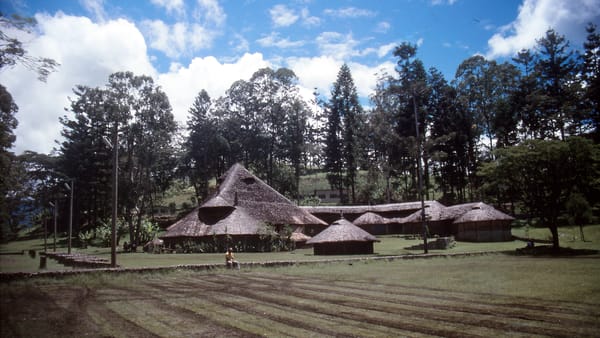
The result was a government disconnected from its people, lacking a unifying vision and plagued by instability from the very beginning. In urban centers like the capital, Port Moresby, as well as cities such as Lae and Mount Hagen, gang violence quickly became a brutal part of daily life. Meanwhile, in the Highlands, life carried on much as it always had, without electricity or running water, and with many mountain clans continuing their traditional conflicts, largely unchecked by a law enforcement system that remained focused on the cities.
Even there, few could rely on the legal system, as corruption became rampant across every level of government. For citizens trying to earn an honest living, the odds were stacked impossibly high. Mass unemployment was a crisis from the start, and the gap between the rich and poor was so vast that many ended up living in shanty towns or directly on the streets.
A small elite, enriched by control over the country’s resources, routinely exploited the vulnerable. Children and adults alike were pulled from the streets and trafficked into forced labor, whether in logging camps, mines, or the sex trade. With survival the top priority, many families were forced to send their children off alone, hoping they could find some way to contribute, no matter the risk.
As is often the case in times of deep crisis, people began to find their own ways to survive. In Papua New Guinea, that survival came in the form of the Raskol gangs, which began to emerge in the 1970s. Boys of all ages were drawn into criminal activity, joining gangs as one of the few available means of income, protection, and support.
Reflecting the fragmented nature of their homeland, no single dominant gang emerged. Instead, numerous groups took shape such as the Boma, the 585s, the Mafia, KGK, and Kips Kaboni. All collectively known as “Raskols.” The term comes from Tok Pisin, the local English-based creole used in commerce and government, where “raskol” means “rascal.”
As the Raskols gained power in cities across PNG, so too did violence, corruption, and lawlessness. Over time, these gangs didn’t just influence the streets, they began to dominate them, to the point where they essentially held sway over the nation’s urban landscape.
Crimes
In the Highlands, much of the violence and crime is still rooted in intertribal warfare. As recently as July 10th, 2019, one such conflict claimed the lives of 32 people, including nine children. While these clashes are a primary driver of crime in rural areas, cities like Port Moresby are forced to contend with nearly everything else thanks to the Raskols.
Raskol gangs are responsible for a wide range of crimes, from robberies and carjackings to kidnappings and assaults, often using a mix of locally sourced, black-market, and homemade weapons. These gangs roam the streets with impunity, and it’s not uncommon to see groups armed with machetes holding up tourists or locals. Even more alarming are the armed robberies involving weapons as heavy as M16 assault rifles.
It’s no surprise why such crimes persist though, as many gang members can earn more in a single robbery than they might in a lifetime of legitimate work. Some of the more organized gangs have expanded their operations to include international arms trafficking, often exchanging locally grown cannabis or other drugs, many of which aren’t even widely used in Papua New Guinea. In fact, despite the country’s many challenges, drug use remains relatively low.
Cannabis is primarily cultivated as a trade commodity, not for domestic consumption. On the streets, there are even individuals who specialize in crafting homemade firearms for the Raskols, which are frequently used in attacks against police, unsuspecting civilians, and rival gangs.
Gang warfare in Papua New Guinea is often open and relentless, erupting in public shootouts, brutal daylight murders, revenge killings, and everything in between. For anyone hoping that local governments might step in to restore law and order, the reality is grim as there’s little hope. In many areas, the Raskols are the law. Through widespread bribery and corruption, much of the police force and government administration operate under the gangs’ influence.
Even worse, many officers are directly involved in criminal activities themselves, from fuel theft to arms trafficking. And they can be just as violent and unpredictable as the gangs they’re supposed to fight, often turning on civilians without hesitation. For the people living in PNG’s cities, safety isn’t even an illusion.
However, this danger extends well past the locals as there have been multiple cases of foreigners falling prey to the Raskols violence. In 2013, and American man, his wife, and a tour guide were doing research on climate change and the effects it had in the region on birds when they were attacked by 9 gang members armed with knives and guns. After stripping the man and guide down naked, the gang tied them to a tree and forced them to watch as they spent the next 20 minutes scalping and gang raping the man’s wife.
The only thing that saved her was a stray noise in the forest that scared the gang off, allowing the victims to break free and run for help. And this came only a week after an Australian tourist had endured the same fate after a gang had viciously killed her friend. Unfortunately, sexual assault, rape, and other similar atrocities are also common throughout PNG, both in the Highlands and in the cities.
In one case that was widely reported in 2003, after a woman had gotten into a car accident, a local group of Raskols dragged her from the wrecked vehicle just to gang rape her as she lay injured and dying. Tragically, this kind of assault has become a disturbingly common tactic among Raskol gangs. So much so that it now forms a recognizable part of their modus operandi.
Initiations
To put it as mildly as possible, rape is more than just a crime committed frequently by the Raskols, it is part of their identity. Any young man who wishes to join one of these gangs must go through an initiation which, usually, is finding a random young woman and forcing themselves on the victim. This is it.
No “curb-stomping” or shooting a rival gang member or any of the similar initiation rituals usually prevalent in gangs throughout the world. Instead, Raskols are ordered to commit one of the worst actions imaginable on an innocent victim who has nothing to do with their groups. Peter Moses, one of the leaders of the 585s, has stated that raping a young woman is a must for young gang members looking to prove themselves.
As Moses, who had self-admittedly done the same to over 30 victims, 3 of whom wound up dead afterwards, has been quoted as saying on the matter:
“and it is better if a boy kills her afterwards; there will be less problems with the police”.
Watch The Project Briefing
Open Video
Video Briefing
Gangs: The Raskols
Meanwhile, in the Highlands, women often face similarly harsh conditions, frequently regarded more as property than as people. In many cases, marriage involves the payment of a “bride price,” during which the woman is effectively sold off, similar to the sale of an old car. Once the transaction is complete, the husband is free to treat his wife however he pleases. Many women throughout PNG endure regular domestic abuse, sexual assault by their partners, and in some cases, even worse.
Tragically, some women are targeted not just by their husbands, but by their entire communities. Belief in witchcraft remains widespread in the Highlands, and women are often accused of practicing “Puri-Puri,” or black magic. When such accusations arise, their families may disown them out of fear of being cursed or punished by association. These women are then forced to flee their homes or face brutal punishments, often culminating in violent attacks by local mobs.
In 2012, Vlad Sokhin released the documentary Crying Meri, in which he traveled to Papua New Guinea to document the widespread mistreatment of women across the country. What he uncovered was tragic, though by that point, sadly unsurprising. Many young Raskols he interviewed openly and proudly admitted to raping at least one woman, with several boasting of even more. When asked why they had never been reported, most claimed that none of their victims had gone to the police.
Disturbed by this, Sokhin decided to dig deeper. He sought out the victims to hear their side of the story. Most of the women he spoke with said they had indeed tried to file reports, but the complaints were either lost within a corrupt system, dismissed by police who had been bribed by the Raskols, or ignored because the victims lacked the money to pay off officers themselves. This, in turn, revealed an entirely separate yet equally alarming issue: systemic corruption and a justice system inaccessible to those without power or money.
Impact
According to the Raskols themselves, the police have been just as cruel and violent as the gangs, often taking out their frustrations on local communities. And they may not be wrong as police brutality is widespread across the country, with authorities commonly adopting a “beat first, ask questions later” approach. As Koiva, a Bomai gang leader, remarked in 2004:
“the police we know are very dangerous. They come in to the settlement and raid people’s food and property and beers.”
At this point, the police have effectively become a gang of their own, often relying on bribes to make a living. Beyond the crimes already mentioned, they’ve been implicated in human trafficking and are known to frequently assault civilians on the street, often in ways that mirror the behavior of the Raskols themselves. In the Highlands, where regulation is even more lax than in the cities, police misconduct can be especially severe. Officers have been reported assaulting young detainees, stripping random citizens naked before robbing them, and committing even more egregious acts.
While most modern nations have government bodies tasked with overseeing and punishing such abuses, the judicial and criminal justice systems in Papua New Guinea operate very differently. Despite being severely under-resourced, the Royal Papua New Guinea Constabulary reports solely to the Ministry of Defense, effectively granting the police unchecked authority. The courts, similarly, underfunded, often lead to trial delays, wrongful imprisonment, and prolonged detentions without due process.
As for the prison system, expectations should remain low. Despite having one of the highest prison occupancy rates in Oceania, PNG’s prisons are overcrowded, poorly maintained, and notoriously violent. Riots, escapes, and acts of brutality are common, and it’s widely believed that, like the police, prison guards can be easily bribed.
Due in no small part to the actions of both the Raskol gangs and the police force, Port Moresby has consistently ranked among the worst cities in the world to live in. In 2004, a survey by The Economist even named it the worst capital city globally out of 130 evaluated. To this day, Raskol gangs control large portions of the city, with entire areas considered no-go zones for police. Residents are routinely advised to stay indoors after sunset and in many neighborhoods, to avoid the streets even during daylight hours. Meanwhile, the city’s wealthier residents live in heavily fortified homes that resemble embassies more than private residences. Barbed wire lines the perimeter, gated entrances are monitored around the clock, and multiple security guards are often employed, just to be safe.
To say that the Raskols have left a lasting impact on Papua New Guinea would be a major understatement. At one point, the murder rate in Port Moresby was reported to be three times higher than Moscow’s and 23 times higher than London’s. Compounding the violence, the country also faces a STD epidemic thanks, in no small part, to the widespread sexual assault, which led to the steady rise of HIV and AIDS cases nationwide.
As of 2020, more than 50,000 people in PNG were living with the disease. However, experts believe these figures are heavily underreported, and many fear the real numbers will surge dramatically in the years ahead.
Response
For years, the very existence of the Raskols went unnoticed by the wider world, let alone the atrocities they were committing in a remote corner of the Pacific Ocean. That changed in 2004, when Australian photographer and author Stephen Dupont decided to travel to Papua New Guinea and document the situation for himself. While there, he managed to infiltrate the Kips Kaboni, Tok Pisin for “Scar Devils”, PNG’s longest-established gang, after earning their trust. Remarkably, he was allowed to set up shop in their safehouse, where he documented their unique homemade weapons and firearms.
At the time, the Kips Kaboni were embroiled in a gang war, and Dupont was given full access to witness it unfold. Allegedly, the violence was sparked when a Motu woman was killed by a Highlander who drove a metal spear through her neck, triggering a brutal vendetta. In retaliation, the Kips Kaboni launched attacks on Highlanders, burning down their stores and properties. Despite being an outsider, Dupont was granted the rare opportunity to photograph freely and even conduct individual profiles of the gang members.
One of the gang members Dupont profiled, a man named Omsy, later appeared in the documentary Crying Meri. In the film, Omsy shared that since Dupont’s visit to Papua New Guinea, he had turned his life around, leaving the gang to become a bass player in a band that was beginning to gain international attention. Despite his new path, he expressed deep shame over the person he had been when the original 2004 profile was made. He admitted that, when he was with the gang, he had raped 5 different women and would regularly hold his wife at knife and gunpoint to get his way.
Despite this kind of behavior being widespread among the gang, Dupont was surprised to find that many Raskols were viewed as heroes within their communities. Much like modern-day Robin Hoods, they were seen by some as necessary criminals, defying a corrupt system and standing up for the powerless. But this perception is deeply misguided.
While it’s true that Papua New Guinea struggles with systemic corruption, there is no excuse for the Raskols’ abominable, violent, and deeply harmful actions. In fact, far from being defenders of the people, these gangs have contributed significantly to many of the modern challenges the nation now faces.
In recent years, politicians such as Prime Minister James Marape have made meaningful strides in the fight against corruption. In 2020, the government passed a bill to establish an Independent Commission Against Corruption, marking the country’s first significant step toward addressing the issue through formal regulation. Alongside this, efforts have been made to raise awareness about drug use in schools through assemblies and other educational initiatives. At the community level, organizations like City Mission’s New Life Farm continue to operate largely independently, offering support through shelters, outreach programs, and various forms of community engagement.
However, many of these efforts are largely ineffective, as there has been little progress in enacting robust legislation to combat issues such as human trafficking, arms trafficking, or gang violence. Problems that are directly related to the Raskols. To this day, they continue to dominate the cities, terrorizing residents at will, committing atrocities, and transforming entire areas into warzones. In short, they remain ruthless figures of terror, and, unless significant changes are made, they will likely continue to control their communities with little opposition for the foreseeable future.
Key Takeaways
- Papua New Guinea’s Raskol gangs have terrorized communities for decades, with little police intervention.
- Raskol initiation rituals involve brutal acts like rape, reflecting the gangs’ deeply violent culture.
- The Raskols’ control extends to influencing corrupt police and government officials, making law enforcement ineffective.
- Women in PNG face extreme violence, including rape and witchcraft accusations, with limited legal recourse.
- Despite some anti-corruption efforts, Raskol gangs continue to dominate cities, committing atrocities with impunity.

Simon Whistler
Simon Whistler is one of YouTube's most prolific documentary presenters, known for calm, authoritative deep dives into true crime, disappearances, and the world's most enduring unsolved cases. Into the Shadows is his companion archive for the cases he can't stop thinking about.
Frequently Asked Questions
What are Raskols?
Raskols are a widespread network of gangs in Papua New Guinea known for their violent and criminal activities. They terrorize communities with robberies, assaults, and other crimes, often operating with impunity due to corruption within the police and government.
How did the Raskols originate?
The Raskols began to emerge in the 1970s as a means of survival for boys and young men in Papua New Guinea. They joined gangs to earn income, protection, and support in a country plagued by mass unemployment and a vast gap between the rich and poor.
What types of crimes do Raskols commit?
Raskols are responsible for a wide range of crimes, including robberies, carjackings, kidnappings, assaults, and sexual violence. They often use a mix of locally sourced, black-market, and homemade weapons, and their activities include international arms trafficking and drug trade.
What is the initiation ritual for joining a Raskol gang?
The initiation ritual for joining a Raskol gang typically involves committing a sexual assault on an innocent victim. This brutal act is seen as a way for young men to prove themselves to the gang.
How do Raskols impact the communities in Papua New Guinea?
Raskols have a devastating impact on communities in Papua New Guinea. They control large portions of cities like Port Moresby, making entire areas no-go zones for police. Residents are advised to stay indoors after sunset, and the city’s wealthier residents live in heavily fortified homes. The gangs contribute to high murder rates, an STD epidemic, and widespread fear and violence.
What is the role of the police in Papua New Guinea regarding the Raskols?
The police in Papua New Guinea are often as violent and unpredictable as the Raskols themselves. Many officers are involved in criminal activities, and the police force is plagued by corruption. They frequently assault civilians and are known to be easily bribed, making them ineffective in combating the Raskols.
What efforts have been made to address the issues caused by the Raskols?
Efforts to address the issues caused by the Raskols include the establishment of an Independent Commission Against Corruption in 2020 and educational initiatives to raise awareness about drug use. However, these efforts have been largely ineffective due to the lack of robust legislation to combat human trafficking, arms trafficking, and gang violence.
How do Raskols view themselves within their communities?
Many Raskols are viewed as heroes within their communities, similar to modern-day Robin Hoods, defying a corrupt system and standing up for the powerless. However, this perception is misguided, as the gangs contribute significantly to the modern challenges the nation faces.
What is the situation like for women in Papua New Guinea, particularly in relation to the Raskols?
Women in Papua New Guinea face severe challenges, including sexual assault, rape, and other atrocities committed by Raskols. In the Highlands, women are often regarded as property and face domestic abuse and violence. The belief in witchcraft also leads to brutal punishments for women accused of practicing black magic.
What is the current state of the prison system in Papua New Guinea?
The prison system in Papua New Guinea is overcrowded, poorly maintained, and notoriously violent. Riots, escapes, and acts of brutality are common, and it is widely believed that prison guards can be easily bribed. The system is severely under-resourced and operates with unchecked authority.
Sources
- Original Into the Shadows video: Gangs: The Raskols
- https://en.wikipedia.org/wiki/Raskol_gangs
- https://powerhousebooks.com/books/raskols-the-gangs-of-indonesia/
- https://www.theguardian.com/world/2004/sep/22/population.davidfickling
- https://ocindex.net/2021/country/papua_new_guinea
- https://time.com/3792640/raskols-stephen-duponts-portraits-of-papua-new-guinea-gangsters/
- https://www.state.gov/wp-content/uploads/2022/02/313615_PAPUA-NEW-GUINEA-2021-HUMAN-RIGHTS-REPORT.pdf
- https://www.youtube.com/watch?v=86in8frImaA
- https://www.ndtv.com/world-news/us-academic-gang-raped-in-papua-new-guinea-519748
- https://www.w4.org/en/wowwire/crying-meri-vlad-sokhin-violence-against-women-papua-new-guinea/
- https://www.vladsokhin.com/work/crying-meri/
- https://www.cnbc.com/2022/08/07/global-liveability-index-2022-best-and-worst-places-to-live.html
- https://pmc.ncbi.nlm.nih.gov/articles/PMC9247692/#:~:text=As%20of%202020%2C%20approximately%2045,figure%20likely%20to%20be%20underreported
- https://www.unaids.org/sites/default/files/country/documents/PNG_2020_countryreport.pdf
- https://citymissionpng.org/
- Hero image source by Australian High Commission Papua New Guinea / openverse, by.